Showing posts with label satellite. Show all posts

Wednesday, February 01, 2012

NASA satellite tastes atoms away from the solar system


NASA's Interstellar Boundary Explorer, the centerpiece of a $169 million mission map the boundary of the sun's influence, has detected atoms from interstellar space streaming by Earth, finding the material is dissimilar from the chemical make-up of the solar system, scientists announced Tuesday.

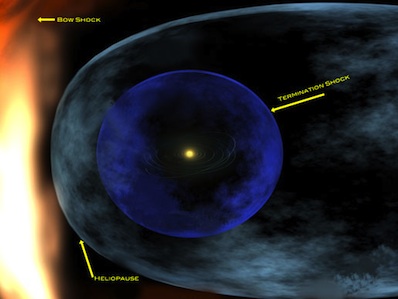
The data recommend the area of interstellar space just outside the solar system may be deficient in oxygen compared to its abundance inside the heliosphere, a teardrop-shaped bubble blown out by the energy from the solar wind. The heliosphere's bubble is compressed ahead of the sun's motion like a bow shock in front of a ship, while it stretches behind the solar system similar to a boat's wake.

The heliosphere blocks most hazardous cosmic radiation from reaching Earth.

Researchers published their results in the Astrophysics Journal on Jan. 31. IBEX found 74 oxygen atoms for every 20 neon atoms in the interstellar material, compared with 111 oxygen atoms for every 20 neon atoms within the solar system.

IBEX, launched in October 2008, uses two instruments to identify energetic neutral atoms as they strike the spacecraft. If the imagers are facing the right direction when the particle meets the satellite, the atom registers and the instrument can distinguish its elemental composition.

IBEX is in an orbit stretching 200,000 miles from Earth, placing the craft outside of the planet's magnetic field, a constraint to detect energetic particles streaming in from the outer heliosphere and interstellar space.

Saturday, December 31, 2011

NASA Conducts Orion Parachute Testing for Orbital Test Flight


NASA successfully conducted a drop test of the Orion crew vehicle's parachutes high above the Arizona desert Tuesday, Dec. 20, in preparation for its orbital flight test in 2014. Orion will carry astronauts deeper into space than ever before, provide emergency abort capability, sustain the crew during space travel and ensure a safe re-entry and landing.

A C-130 plane dropped the Orion test article from an altitude of 25,000 feet above the U.S. Army's Yuma Proving Grounds. Orion's drogue chutes were deployed between 15,000 and 20,000 feet, followed by the pilot parachutes, which then deployed two main landing parachutes. This particular drop test examined how Orion would land under two possible failure scenarios.

Orion's parachutes are designed to open in stages, which is called reefing, to manage the stresses on the parachutes after they are deployed. The reefing stages allow the parachutes to sequentially open, first at 54 percent of the parachutes' full diameter, and then at 73 percent. This test examined how the parachutes would perform if the second part of the sequence was skipped.

Diamond stud earrings

Read more

Thursday, October 20, 2011

NASA postpones climate satellite launch to Oct 28


WASHINGTON — NASA on Wednesday set October 28 for its planned launch of a satellite to help weather forecasters predict extreme storms and offer scientists a better view of climate change.

The 1.5 billion dollar National Polar-orbiting Operational Environmental Satellite System Preparatory Project (NPP) is the first to measure both short and long term changes in weather and climate, the US space agency said.

The launch, initially set for October 27, "has been retargeted for Oct 28," NASA said in a message on the micro-blogging site Twitter.

The satellite will launch from Vandenberg Air Force Base in California between 5:48 am Eastern time (0948 GMT) and 5:57 am (0957 GMT).

The SUV-sized satellite will carry five instruments to study temperature and water in the atmosphere, how clouds and aerosols affect temperature, and how plants on land and in the ocean respond to environmental changes.

"This is really the first mission that is designed to provide observations for both weather forecasters and climate researchers," Jim Gleason, NPP project scientist, told reporters earlier this month.

"NPP's observations will help scientists better predict the future environment and these prediction are incredibly valuable for economic, security and humanitarian reasons."

The satellite is one of 14 Earth observation missions currently being managed by NASA. Project managers said they hope it will operate for about five years.

Diamond Earring Studs

Read more

Thursday, October 13, 2011

NASA to Launch New Satellite to Track Earth's Weather, Climate


A new NASA satellite that will be the first geared at observing key aspects of both Earth's climate and its weather is slated for launch on Oct. 27, the space agency announced today. The National Polar-Orbiting Operational Environmental Satellite System Preparatory Project (NPP) is the first mission designed to collect critical data to improve weather forecasts in the short-term and increase our understanding of long-term climate change.

NPP's five science instruments, including four new state-of-the-art sensors, will provide scientists with data to extend more than 30 key data records that have been kept for decades by a cadre of Earth-observing satellites. These records, which range from the ozone layer and land cover to atmospheric temperatures and ice cover, are critical for understanding and predicting changes in global climate.

"NPP's observations of a wide range of interconnected Earth properties and processes will give us the big picture of how our planet changes," said Jim Gleason, NPP project scientist at NASA's Goddard Space Flight Center in Greenbelt, Md.

"That will help us improve our computer models that predict future environmental conditions," Gleason added. "Better predictions will let us make better decisions, whether it is as simple as taking an umbrella to work today or as complex as responding to a changing climate."

Meteorologists with the National Oceanic and Atmospheric Administration (NOAA) will incorporate NPP data into their weather prediction models to produce forecasts and warnings that will help emergency responders anticipate, monitor and react to many types of natural disasters.

"The timing of the NPP launch could hardly be more appropriate," said Louis W. Uccellini, director of NOAA's National Centers for Environmental Prediction in Camp Springs, Md. "With the many billion dollar weather disasters in 2011, NPP data is critical for accurate weather forecasts into the future."

Diamond Studs

Read more

Wednesday, October 12, 2011

Another satellite set to crash back to Earth


Well, you may have been lucky last time, but there's another satellite heading back to Earth, and this time it's much more likely that it'll land on your head.

Just a couple of weeks ago, the Upper Atmosphere Research Satellite (UARS) plunged safely into the south Pacific Ocean, six years after completing its mission.

And, now, a German research satellite called ROSAT is set to make a similar return to Earth in the next two or three weeks. It's an X-ray telescope weighing nearly three tons, that's been orbiting since 1990.

However, communication was lost in 1999, and the German Aerospace Centre (DLR) has lost control. There were suggestions at the time that the satellite's failure was triggered by a hacking attack from Russia.

ROSAT's now orbiting at around 270km above the Earth, descending slowly.

It's unlikely to burn up entirely on re-entry, because of the large amount of ceramics and glass used in construction - and this could mean that many pieces of debris would be razor-sharp.

Diamond Studs

Read more

Friday, September 30, 2011

Another Dead Satellite to Crash Land in November


A defunct NASA satellite that fell to Earth last week sparked some worldwide buzz, but it's not the only spacecraft falling out of space.

The decommissioned German X-ray space observatory, called the Roentgen Satellite or ROSAT, will tumble to Earth sometime in early November, but it's still too early to pinpoint exactly when and where debris from the satellite will land, according to officials at the German Aerospace Center.

The 2.4-ton spacecraft's orbit extends from the latitudes of 53 degrees north and south, which means the satellite could fall anywhere over a huge swath of the planet — stretching from Canada to South America, German Aerospace officials said. [6 Biggest Uncontrolled Spacecraft Falls From Space]

The latest estimates suggest that up to 30 large pieces of the satellite could survive the intense and scorching journey through Earth's atmosphere. In all, about 1.6 tons of the satellite components could reach the surface of the Earth, according to German Aerospace officials.

The re-entry will be similar to NASA's 6-ton Upper Atmosphere Research Satellite (UARS), which plunged into the southern Pacific Ocean on Saturday (Sept. 24).

ROSAT coming home

In 1998, ROSAT's star tracker failed, which caused its onboard camera to be pointed directly at the sun. The event permanently damaged the spacecraft and ROSAT was officially decommissioned in February 1999.

Scientists are actively tracking the dead satellite, but many of the details will remain uncertain until roughly two hours before it hits Earth.

"It is not possible to accurately predict ROSAT's re-entry," Heiner Klinkrad, head of the Space Debris Office at the European Space Agency, said in a webcast posted on the German Aerospace Center's website. "The uncertainty will decrease as the moment of re-entry approaches. It will not be possible to make any kind of reliable forecast about where the satellite will actually come down until about one or two hours before the fact."

It will, however, be possible to rule out certain geographical regions from the potential drop zone about a day in advance, Klinkrad said. The largest piece of debris is expected to be the telescope's heat resistant mirror.

"Generally speaking, whenever a satellite re-enters the atmosphere, about 20 to 40 percent of its mass actually reaches the Earth’s surface," Klinkrad said. "In the case of ROSAT, this figure could be slightly higher because one of its characteristic features is that it carries heat-resistant mirror structures on board." [Related: Falling Satellites & Space Junk: Q&A with Orbital Debris Expert]

Diamond stud

Read more


Wednesday, September 28, 2011

NASA Plans High-Speed Space Communications System


NASA is working on a laser-based optical communications system that will drastically reduce the time it takes to transmit multimedia from space, with data moving at rates up to 100 times faster than current systems.

The space agency aims to show off a high-speed communications system through a Laser Communications Relay Demonstration (LCRD) in 2016. LCRD is one of three next-generation space technologies NASA is working on as part of its plans to create more sophisticated solutions to meet goals for the future of its space program.

Now that NASA has retired its space shuttle program, the agency aims to send manned spacecraft beyond low-Earth orbit and push the boundaries of current space communications, among other aims.

To the latter point, while it currently takes 90 minutes to transmit high-resolution images from Mars, LCRD will allow for actual streaming of high-definition video from distances beyond the moon, according to the space agency.

NASA's Goddard Space Flight Center came up the idea for the LCRD, which is now being developed by a cross-organizational team that also includes NASA's Jet Propulsion Laboratory and the Lincoln Laboratory at the Massachusetts Institute of Technology. NASA will fly the system into space on a commercial communications satellite developed by Space Systems/Loral.

Dave Israel, who is leading the team developing the network, compared current NASA space communications capability to dial-up Internet speeds. Just as the home Internet user "hit the wall" with that technology, he said in a statement that NASA "is approaching the limit of what its existing communications network can handle."

LCRD, on the other hand, will be more comparable to a land-based optical network such as FIOS from Verizon, Israel added.

Read more

Sunday, September 25, 2011

Huge UARS Satellite's Fall From Space Captivates Skywatchers, Sparks Hoaxes


Skywatchers around the world were hoping for some unique views overnight Friday (Sept. 23), as a NASA satellite plunged to Earth on its final scorching journey through the atmosphere.

The 6.5-ton Upper Atmosphere Research Satellite, or UARS, most likely pierced through Earth's atmospheric shield within 20 minutes of 12:16 a.m. EDT Saturday (0416 GMT), according to NASA officials. The agency is unable to confirm the precise time and location of the satellite's re-entry, but orbital debris scientists said that the satellite would have been flying over the vast Pacific Ocean at the time, well away from the North American coastline.

Throughout the night, rumors circulated that the defunct satellite crashed over Alberta, Canada, raining debris on the small town of Okotoks, which lies south of Calgary. Local authorities who were called to investigate later called the claims a hoax. [6 Biggest Spacecraft to Fall Uncontrolled From Space]

Read more

Thursday, September 22, 2011

Landing of Dead NASA Satellite 'Too Early to Predict': NASA


A dead 6.5 ton NASA UARS satellite would make its re-entry into Earth's atmosphere on Friday, Sept. 23, bringing along a chance to watch a spectacular sky show. But NASA is still not sure where on Earth the satellite would land.

"It is still too early to predict the time and location of re-entry with any more certainty, but predictions will become more refined in the next 24 to 48 hours," National Aeronautics and Space Administration (NASA) said in a statement.

NASA added that the debris from the defunct satellite would not cause harm to humans.

NASA conducted a detailed re-entry risk assessment for UARS in 2002 and it showed that the debris from UARS is not harmful to human beings. Following are the excerpts of the study:

* Number of potentially hazardous objects expected to survive: 26

* Total mass of objects expected to survive: 532 kg

* Estimated human casualty risk (updated to 2011): About 1 in 3200

Read more

Tuesday, September 20, 2011

Tonnes of satellite space junk to pelt earth on weekend


Look out for a six-tonne satellite plummeting from the sky this weekend.

NASA scientists are doing their best to predict exactly when and where it will fall.

For now, they believe the earliest it will hit is Friday (NZ time), while the latest is Sunday.

Scientists put the odds of it hitting someone at 1-in-3200.

Over the years, space debris has fallen into the ocean or empty spaces.

If you do come across what you think may be a satellite piece, NASA doesn't want you to pick it up.

Or sell it on eBay.

As US government-owned property, it should be returned to its rightful owner – by being reported to police.

The 20-year-old research satellite is expected to break into more than 100 pieces as it enters the atmosphere, most of it burning up, the New Zealand Herald reports.

Twenty-six of the heaviest metal parts are expected to reach Earth, the biggest chunk weighing about 136 kilograms. The debris could be scattered over an area about 800 kilometres long.

Read more

Monday, September 19, 2011

NASA satellite expected to crash to Earth in days


The sky is not falling. A 12,500-pound NASA satellite the size of a school bus is, though.

It's the Upper Atmosphere Research Satellite, and it's tumbling in orbit and succumbing to Earth's gravity. It will crash to the surface Friday.

Or maybe Thursday. Or Saturday.

Out-of-control crashing satellites don't lend themselves to exact estimates even for the precision-minded folks at NASA. The uncertainty about the "when" makes the "where" all the trickier, because a small change in the timing of the re-entry translates into thousands of miles of difference in the crash site.

As of the moment, NASA says the 35-foot-long satellite will crash somewhere between 57 degrees north latitude and 57 degrees south latitude - a projected crash zone that covers most of the planet, and particularly the inhabited parts. In this hemisphere, that includes everyone living between northern Newfoundland and the frigid ocean beyond the last point of land in South America.

Polar bears and Antarctic scientists are safe.

It's the biggest piece of NASA space junk to fall to Earth in more than 30 years. It should create a light show. The satellite will partially burn up during re-entry, and, by NASA's calculation, break into about 100 pieces, creating fireballs that should be visible even in daytime.

An estimated 26 of those pieces will survive the re-entry burn and will spray themselves in a linear debris field 500 miles long. The largest chunk should weigh about 300 pounds.

As the Friday-ish crash gets closer, NASA will refine its estimate of timing and location, but the fudge factor will remain high.

"There are too many variations on solar activity which affect the atmosphere, the drag on the vehicle," said Nicholas Johnson, chief scientist for orbital debris at NASA.

The good news is that the satellite will probably splatter into the open ocean, because Earth is a water planet. And humans, for all their sprawl, occupy a very limited portion of its surface.

Read more


Thursday, September 15, 2011

Satellite falls faster than forecast


NASA's Upper Atmosphere Research Satellite is now expected to fall to Earth sometime between Sept. 23 and 25, orbital experts reported today.

That's toward the early end of the original projections for UARS' fiery descent: Last week, when NASA announced that the long-defunct, six-ton satellite would crash, the time frame was given as late September to early October. That wide window of possibilities was due to the uncertainties over atmospheric conditions. Now the picture is becoming clearer, said Nicholas Johnson, head of NASA's Orbital Debris Program Office at Johnson Space Center in Texas.

"The sun has become very active since the beginning of this week, and it's accelerating the prediction," he told me.

Higher solar activity heats and expands the upper atmosphere, creating more drag for satellites in decaying orbits. The increased drag pulls down those satellites more quickly — and that's what's behind the earlier prediction.

NASA's UARS status page said the bus-sized satellite's orbit was 143 by 158 miles (230 by 255 kilometers) as of today, compared with 155 by 174 miles (250 by 280 kilometers) a week ago. Johnson said the status page would be updated again on Friday.

Read more