Showing posts with label space images. Show all posts

Wednesday, September 28, 2011

NASA Plans High-Speed Space Communications System


NASA is working on a laser-based optical communications system that will drastically reduce the time it takes to transmit multimedia from space, with data moving at rates up to 100 times faster than current systems.

The space agency aims to show off a high-speed communications system through a Laser Communications Relay Demonstration (LCRD) in 2016. LCRD is one of three next-generation space technologies NASA is working on as part of its plans to create more sophisticated solutions to meet goals for the future of its space program.

Now that NASA has retired its space shuttle program, the agency aims to send manned spacecraft beyond low-Earth orbit and push the boundaries of current space communications, among other aims.

To the latter point, while it currently takes 90 minutes to transmit high-resolution images from Mars, LCRD will allow for actual streaming of high-definition video from distances beyond the moon, according to the space agency.

NASA's Goddard Space Flight Center came up the idea for the LCRD, which is now being developed by a cross-organizational team that also includes NASA's Jet Propulsion Laboratory and the Lincoln Laboratory at the Massachusetts Institute of Technology. NASA will fly the system into space on a commercial communications satellite developed by Space Systems/Loral.

Dave Israel, who is leading the team developing the network, compared current NASA space communications capability to dial-up Internet speeds. Just as the home Internet user "hit the wall" with that technology, he said in a statement that NASA "is approaching the limit of what its existing communications network can handle."

LCRD, on the other hand, will be more comparable to a land-based optical network such as FIOS from Verizon, Israel added.

Read more

Friday, January 07, 2011

NASA Research Team Reveals Moon Has Earth-Like Core

moon
Uncovering details about the lunar core is critical for developing accurate models of the moon's formation. The data sheds light on the evolution of a lunar dynamo -- a natural process by which our moon may have generated and maintained its own strong magnetic field.

The team's findings suggest the moon possesses a solid, iron-rich inner core with a radius of nearly 150 miles and a fluid, primarily liquid-iron outer core with a radius of roughly 205 miles. Where it differs from Earth is a partially molten boundary layer around the core estimated to have a radius of nearly 300 miles. The research indicates the core contains a small percentage of light elements such as sulfur, echoing new seismology research on Earth that suggests the presence of light elements -- such as sulfur and oxygen -- in a layer around our own core.

The researchers used extensive data gathered during the Apollo-era moon missions. The Apollo Passive Seismic Experiment consisted of four seismometers deployed between 1969 and 1972, which recorded continuous lunar seismic activity until late-1977.

"We applied tried and true methodologies from terrestrial seismology to this legacy data set to present the first-ever direct detection of the moon's core," said Renee Weber, lead researcher and space scientist at NASA's Marshall Space Flight Center in Huntsville, Ala.

Wednesday, December 22, 2010

Christmas at the Moon

Christmas Eve, 1968. As one of the most turbulent, tragic years in American history drew to a close, millions around the world were watching and listening as the Apollo 8 astronauts -- Frank Borman, Jim Lovell and Bill Anders -- became the first humans to orbit another world.

As their command module floated above the lunar surface, the astronauts beamed back images of the moon and Earth and took turns reading from the book of Genesis, closing with a wish for everyone "on the good Earth."

Friday, December 10, 2010

Explosion of Infrared Light

A circular rainbow appears like a halo around an exploded star in this new view of the IC 443 nebula from NASA's Wide-field Infrared Survey Explorer, or WISE.

When massive stars die, they explode in tremendous blasts, called supernovae, which send out shock waves. The shock waves sweep up and heat surrounding gas and dust, creating supernova remnants like the one pictured here. The supernova in IC 443 happened somewhere between 5,000 and 10,000 years ago.

In this WISE image, infrared light has been color-coded to reveal what our eyes cannot see. The colors differ primarily because materials surrounding the supernova remnant vary in density. When the shock waves hit these materials, different gases were triggered to release a mix of infrared wavelengths.

Monday, December 06, 2010

the Falcon 9 Merlin 1C engines


The first SpaceX Falcon 9 demonstration launch for NASA's Commercial Orbital Transportation Services program is targeted for liftoff on Tuesday, Dec. 7. Liftoff will occur from Launch Complex 40 at Cape Canaveral Air Force Station in Florida. The launch window extends from 9:03 a.m. to 12:22 p.m. EST. If necessary, launch opportunities also are available on Dec. 8 and Dec. 9 with the same window.

Known as COTS 1, the launch is the first flight of the Dragon spacecraft and the first commercial attempt to re-enter a spacecraft from orbit. This is the first of three test launches currently planned in the Falcon 9 test flight series. It is intended as a demonstration mission to prove key capabilities such as launch, structural integrity of the Dragon spacecraft, on-orbit operation, re-entry, descent and splashdown in the Pacific Ocean.

NASA established the COTS program to procure a commercial launch service to stimulate the commercial space industry, to facilitate a private industry cargo capability to the International Space Station as soon as achievable, and to achieve cost-effective access to low Earth orbit that will attract private customers.

Thursday, October 07, 2010

NASA astronaut launch video


NASA astronaut Scott Kelly and Russian cosmonauts Oleg Skripochka and Alexander Kaleri launched in their Soyuz TMA-01M spacecraft from the Baikonur Cosmodrome in Kazakhstan Thursday at 7:10 p.m. EDT (Friday, Kazakhstan time) beginning a two-day journey to the International Space Station.

Less than 10 minutes after launch, their spacecraft reached orbit and its antennas and solar arrays were deployed.

The trio will dock to the Poisk module Saturday at 8:02 p.m. completing the Expedition 25 crew. Kelly, Skripochka and Kaleri will begin a five-month tour of duty aboard the orbiting laboratory.

Welcoming them aboard will be current station residents, Expedition 25 Commander Doug Wheelock and Flight Engineers Fyodor Yurchikhin and Shannon Walker. Wheelock, Yurchikhin and Walker arrived June 17 aboard their Soyuz TMA-19 spacecraft.

Wednesday, October 06, 2010

MAVEN Mission to Investigate How Sun Steals Martian Atmosphere


The Red Planet bleeds. Not blood, but its atmosphere, slowly trickling away to space. The culprit is our sun, which is using its own breath, the solar wind, and its radiation to rob Mars of its air. The crime may have condemned the planet's surface, once apparently promising for life, to a cold and sterile existence.

Features on Mars resembling dry riverbeds, and the discovery of minerals that form in the presence of water, indicate that Mars once had a thicker atmosphere and was warm enough for liquid water to flow on the surface. However, somehow that thick atmosphere got lost in space. It appears Mars has been cold and dry for billions of years, with an atmosphere so thin, any liquid water on the surface quickly boils away while the sun's ultraviolet radiation scours the ground.

Tuesday, September 14, 2010

Chandra Finds Evidence for Stellar Cannibalism


The composite image on the left shows X-ray and optical data for BP Piscium (BP Psc), a more evolved version of our Sun about 1,000 light years from Earth. Chandra X-ray Observatory data are colored in purple, and optical data from the 3-meter Shane telescope at Lick Observatory are shown in orange, green and blue. BP Psc is surrounded by a dusty and gaseous disk and has a pair of jets several light years long blasting out of the system. A close-up view is shown by the artist's impression on the right. For clarity a narrow jet is shown, but the actual jet is probably much wider, extending across the inner regions of the disk. Because of the dusty disk, the star’s surface is obscured in optical and near infrared light. Therefore, the Chandra observation is the first detection of this star in any wavelength.

The disk and the jets, seen distinctly in the optical data, provide evidence for a recent and catastrophic interaction in which BP Psc consumed a nearby star or giant planet. This happened when BP Psc ran out of nuclear fuel and expanded into its "red giant" phase.

Colorado's Reservoir Road Fire from Space


Colorado's "Reservoir Road Fire" from Space

NASA's Aqua satellite flies around the Earth twice a day and captures visible and infrared imagery. On Sept. 12 at 19:20 UTC (3:20 p.m. EDT), the Moderate Resolution Imaging Spectroradiometer (MODIS) instrument on Aqua captured a visible image of the "Reservoir Road Fire" that is currently raging in the Arapaho & Roosevelt National Forests / Pawnee National Grassland.

According to the National Forest Incident report on September 13, the Reservoir Road Fire near Loveland, Colorado, has burned 600 acres, and firefighting continues. Loveland is the second most populous city in Larimer County, Colo. Loveland is located 46 miles north of Denver.

Thursday, September 09, 2010

Tropical Depression Hermine


Tropical cyclones are usually big rainmakers once they make landfall and they start to fizzle out, and Hermine, now a tropical depression over Texas is no exception. Rainfall data on Hermine's heavy rains were gathered by NASA and the Japanese Space Agency's Tropical Rainfall Measuring Mission (TRMM) satellite. That data was used to create a map of potential flood areas that showed areas of flooding and potential flooding over a large area in southeastern and central Texas.

Hal Pierce of NASA's TRMM team at the NASA Goddard Space Flight Center in Greenbelt, Md. used the rainfall data from TRMM's rainfall measurements and various reporting stations to create a flood potential map. The map is color-coded and depicts areas with severe flood potential on Sept, 8.

Thursday, September 02, 2010

Science and Maintenance for Station Crew


As part of the ongoing Russian Seiner experiment, Expedition 24 Commander Alexander Skvortsov photographed and documented developments and conditions in the Earth’s oceans Wednesday. His unique perspective of the oceans provides scientists on the ground with current position coordinates of bioproductive water areas.

Flight Engineer Mikhail Kornienko worked with the PILOT-M experiment. PILOT-M is an ongoing experiment that examines the effects of long-duration space flight and stress on the ability of crew members to complete manual spacecraft control tasks.

Flight Engineer Shannon Walker set up the Space Linear Acceleration Mass Measurement Device (SLAMMD) experiment and performed body mass measurements. SLAMMD follows Newton's Second Law of Motion by having two springs generate a known force against a crew member mounted on an extension arm, the resulting acceleration being used to calculate the subject's mass, in effect weighing the individuals.

Using the Fluid Servicing System, Walker also refilled the Columbus laboratory’s Internal Active Thermal Control System with a water-based coolant.

Monday, August 30, 2010

Successful Ice Cloud and Land Elevation Mission


orbiting sentinels is expected to return to Earth in a few days. The agency's Ice, Cloud, and land Elevation (ICESat) satellite completed a very productive scientific mission earlier this year. NASA lowered the satellite's orbit last month and then decommissioned the spacecraft in preparation for re-entry. It is estimated that the satellite will re-enter the Earth's atmosphere and largely burn up on or about August 29.

ICESat's lasting legacy will be its impact on the understanding of ice sheet and sea ice dynamics. The mission has led to scientific advances in measuring changes in the mass of the Greenland and Antarctic ice sheets, polar sea ice thickness, vegetation-canopy heights, and the heights of clouds and aerosols. Using ICESat data, scientists identified a network of lakes beneath the Antarctic ice sheet. ICESat introduced new capabilities, technology and methods such as the measurement of sea ice freeboard – or the amount of ice and snow that protrudes above the ocean surface - for estimating sea ice thickness.

Tuesday, August 24, 2010

Perseids Complete 2010


The 2010 Perseid meteor shower is drawing to a close after painting brilliant streaks across the August nighttime skies. This year's shower began around July 17, peaked August 12-13 and will be officially over by August 24.

"The Perseids are a great shower, one I look forward to every year. And this year didn’t disappoint!" said Dr. Bill Cooke, head of NASA's Meteoroid Environment Office, located at the Marshall Space Flight Center in Huntsville, Ala.

The Perseid meteor shower has been observed for at least 2,000 years and is associated with the comet 109P/Swift-Tuttle, which orbits the sun once every 133 years or so. Each year in August, the Earth passes through a cloud of the comet's debris. These bits of ice and dust travel around 132,000 mph, burning up about 56 miles overhead in the Earth's atmosphere to create one of the best meteor showers of the year. The shower is called the "Perseids" because the meteors appear to come from the direction of the constellation Perseus.

Monday, August 16, 2010

NRC's 2010 Astrophysics Decadal Survey


National Research Council's Astro2010 report, New Worlds, New Horizons in Astronomy and Astrophysics. We appreciate the science community's efforts in defining a set of compelling science objectives for space-based astrophysical research for the coming decade, and for carefully considering the cost of the initiatives the report recommends.

We look forward to assessing the report's findings and recommendations for strengthening the nation's world-class space astrophysics program. From new worlds to new physics, the coming decade of discovery leverages not only our current space observatories – such as the Hubble, Spitzer, Chandra and Fermi space telescopes – but also our planned facilities – especially those from previous decadal surveys, the James Webb Space Telescope and the Stratospheric Observatory for Infrared Astronomy (SOFIA). The survey calls for new facilities that expand our reach into the cosmos that will include opportunities for coordination and cooperation with other Federal agencies and international partners.

Wednesday, August 11, 2010

Launch Preps Move Ahead for Mission to International Space Station

During space shuttle Discovery's final spaceflight, the STS-133 crew members will take important spare parts to the International Space Station along with the Express Logistics Carrier-4. Discovery is being readied for flight inside Kennedy's Orbiter Processing Facility-3 while its solid rocket boosters are stacked inside the nearby Vehicle Assembly Building. STS-133 is slated to launch Nov. 1.

Tuesday, August 10, 2010

Crew to Perform Second of Three Spacewalks Wednesday

Flight controllers and engineers continue meetings to review the results from the first spacewalk conducted Saturday by International Space Station Expedition 24 Flight Engineers Doug Wheelock and Tracy Caldwell Dyson and to plan for the second of what now will be three spacewalks to complete the replacement of a failed pump module on the station’s starboard truss.

In the wake of an eight-hour, three-minute spacewalk Saturday that fell short of removing the failed pump module due to a leak in the fourth of four ammonia line connectors hooked up to the old pump, mission operations and station program officials laid out a series of procedures for Wheelock and Caldwell Dyson to perform at the beginning of the second spacewalk Wednesday designed to greatly reduce, or eliminate the possibility of ammonia leaking from the final fluid connector – called M3 – when it is demated to set the stage for the failed pump to be removed from the truss.

Thursday, July 22, 2010

Spitzer Space Telescope

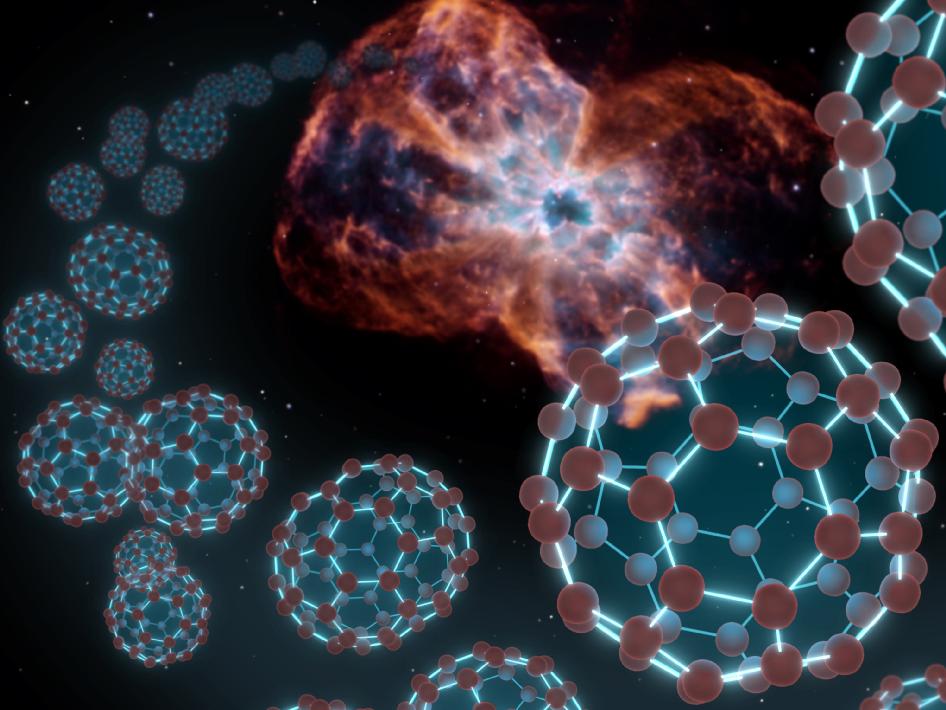
Astronomers using NASA's Spitzer Space Telescope have discovered carbon molecules, known as "buckyballs," in space for the first time. Buckyballs are soccer ball shaped molecules that were first observed in a laboratory 25 years ago.

They are named for their resemblance to architect Buckminster Fuller's geodesic domes, which have interlocking circles on the surface of a partial sphere. Buckyballs were thought to float around in space, but had escaped detection until now.

Tuesday, June 22, 2010

Pacific Ocean sea surface

"The central equatorial Pacific Ocean could stay colder than normal into summer and beyond. That's because sea level is already about 10 centimeters (4 inches) below normal, creating a significant deficit of the heat stored in the upper ocean," said JPL oceanographer and climatologist Bill Patzert. "The next few months will reveal if the current cooling trend will eventually evolve into a long-lasting La Niña situation."

A La Niña is essentially the opposite of an El Niño. During a La Niña, trade winds in the western equatorial Pacific are stronger than normal, and the cold water that normally exists along the coast of South America extends to the central equatorial Pacific. La Niñas change global weather patterns and are associated with less moisture in the air, resulting in less rain along the coasts of North and South America. They also tend to increase the formation of tropical storms in the Atlantic.

"For the American Southwest, La Niñas usually bring a dry winter, not good news for a region that has experienced normal rain and snowpack only once in the past five winters," said Patzert.

Thursday, June 17, 2010

Astronomers Discover Star-Studded Galaxy Tail

"The gas in this galaxy is being blown back into a turbulent wake," said Janice Hester of the California Institute of Technology in Pasadena, lead author of a recent study published in the Astrophysical Journal Letters. "The gas is like sand caught up by a stiff wind. However, the particular type of gas that is needed to make stars is heavier, like pebbles, and can't be blown out of the galaxy. The new Galaxy Evolution Explorer observations are teaching us that this heavier, star-forming gas can form in the wake, possibly in swirling eddies of gas."

Collisions between galaxies are a fairly common occurrence in the universe. Our Milky Way galaxy will crash into the Andromeda galaxy in a few billion years. Galaxies tangle together, kicking gas and dust all around. Often the battered galaxies are left with tails of material stripped off during the violence.

The astronomers were able to find this tail with the help of the Galaxy Evolution Explorer. Clusters of massive, young stars speckle the tail, and these stars glow with ultraviolet light that the space telescope can see. The young stars tell scientists that a crucial ingredient for star formation - dense clouds of gas called molecular hydrogen - formed in the wake of this galaxy's plunge. This is the first time astronomers have found solid evidence that clouds of molecular hydrogen can form under the violent conditions present in a turbulent wake.

Monday, June 14, 2010

JPL's Next Mars Rover Landing Radar Tested at Dryden


Testing for the JPL-managed Mars Science Laboratory or MSL project included suspending a full-scale engineering model of the MSL rover from a helicopter and flying pre-planned flight trajectories over Rogers Dry Lake at Edwards to simulate the rover's descent stage carrying the rover to the surface of Mars. JPL engineers needed to verify that the radar will provide accurate altitude and velocity measurements at Mars and that the suspended rover will not confuse the ability of the descent stage's radar to accurately calculate the rover's descent speed for a safe, on-target landing.

"Dryden offers a unique location to perform testing of this kind," said Carrie Rhoades, the Dryden flight operations engineer managing the MSL project at Dryden. "We have restricted airspace and a large dry lakebed that is useful in simulating several Mars-like features. Dryden is also conveniently close to JPL, so troubleshooting the system and fixing any issues has been relatively easy to accomplish," she said.