Showing posts with label sSpace shuttle Endeavour. Show all posts

Thursday, December 30, 2010

Cassini Celebrates 10 Years Since Jupiter Encounter

Ten years ago, on Dec. 30, 2000, NASA's Cassini spacecraft made its closest approach to Jupiter on its way to orbiting Saturn. The main purpose was to use the gravity of the largest planet in our solar system to slingshot Cassini towards Saturn, its ultimate destination. But the encounter with Jupiter, Saturn's gas-giant big brother, also gave the Cassini project a perfect lab for testing its instruments and evaluating its operations plans for its tour of the ringed planet, which began in 2004.

"The Jupiter flyby allowed the Cassini spacecraft to stretch its wings, rehearsing for its prime time show, orbiting Saturn," said Linda Spilker, Cassini project scientist based at NASA's Jet Propulsion Laboratory in Pasadena, Calif. "Ten years later, findings from the Jupiter flyby still continue to shape our understanding of similar processes in the Saturn system."

Cassini spent about six months - from October 2000 to March 2001 - exploring the Jupiter system. The closest approach brought Cassini to within about 9.7 million kilometers (6 million miles) of Jupiter's cloud tops at 2:05 a.m. Pacific Time, or 10:05 a.m. UTC, on Dec. 30, 2000.

Cassini captured some 26,000 images of Jupiter and its moons over six months of continual viewing, creating the most detailed global portrait of Jupiter yet.

Tuesday, December 21, 2010

Total Lunar Eclipse


Early in the morning on December 21 a total lunar eclipse will be visible to sky watchers across North America (for observers in western states the eclipse actually begins late in the evening of December 20), Greenland and Iceland. Viewers in Western Europe will be able to see the beginning stages of the eclipse before moonset, and in western Asia the later stages of the eclipse will be visible after moonrise.

From beginning to end, the eclipse will last about three hours and twenty-eight minutes. For observers on the east coast of the U.S. the eclipse lasts from 1:33am EST through 5:01 a.m. EST. Viewers on the west coast will be able to tune in a bit earlier. For them the eclipse begins at 10:33 p.m. PST on December 20 and lasts until 2:01am PST on Dec. 21. Totality, the time when Earth's shadow completely covers the moon, will last a lengthy 72 minutes.

Wednesday, November 24, 2010

Inspections Complete on Repaired Tank Stringers


Teams have completed final inspections on the stringer repair work on space shuttle Discovery's external fuel tank at NASA's Kennedy Space Center in Florida. The environmental enclosure, built to support foaming operations, was removed. Flight Crew Systems middeck stow operations are under way.

The Space Shuttle Program will review the analysis and repairs that are required to safely launch shuttle Discovery on its STS-133 mission at a special Program Requirements Control Board session Wednesday. Pending a successful review of the flight rationale at that meeting, a Launch Status Briefing would be held with senior NASA management on Monday, Nov. 29 at Kennedy.

Kennedy's “Call-to-Stations” to begin the launch countdown will be no earlier than Nov. 30, supporting a first launch attempt no earlier than Dec. 3 at about 2:52 a.m. EST.

Tuesday, August 24, 2010

Perseids Complete 2010


The 2010 Perseid meteor shower is drawing to a close after painting brilliant streaks across the August nighttime skies. This year's shower began around July 17, peaked August 12-13 and will be officially over by August 24.

"The Perseids are a great shower, one I look forward to every year. And this year didn’t disappoint!" said Dr. Bill Cooke, head of NASA's Meteoroid Environment Office, located at the Marshall Space Flight Center in Huntsville, Ala.

The Perseid meteor shower has been observed for at least 2,000 years and is associated with the comet 109P/Swift-Tuttle, which orbits the sun once every 133 years or so. Each year in August, the Earth passes through a cloud of the comet's debris. These bits of ice and dust travel around 132,000 mph, burning up about 56 miles overhead in the Earth's atmosphere to create one of the best meteor showers of the year. The shower is called the "Perseids" because the meteors appear to come from the direction of the constellation Perseus.

Thursday, July 22, 2010

Spitzer Space Telescope

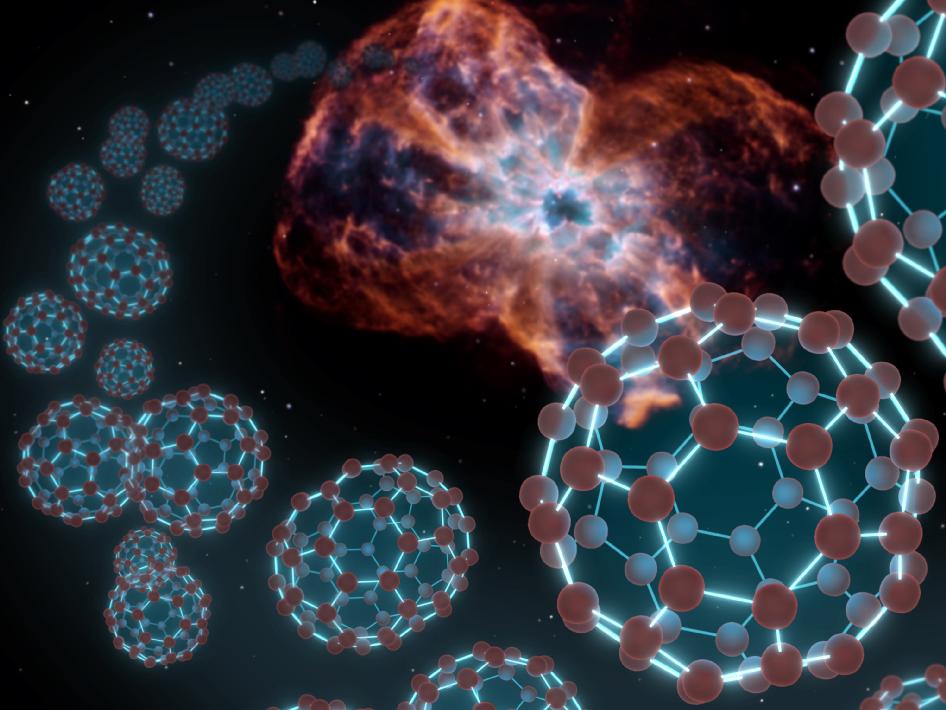
Astronomers using NASA's Spitzer Space Telescope have discovered carbon molecules, known as "buckyballs," in space for the first time. Buckyballs are soccer ball shaped molecules that were first observed in a laboratory 25 years ago.

They are named for their resemblance to architect Buckminster Fuller's geodesic domes, which have interlocking circles on the surface of a partial sphere. Buckyballs were thought to float around in space, but had escaped detection until now.

Thursday, June 17, 2010

Astronomers Discover Star-Studded Galaxy Tail

"The gas in this galaxy is being blown back into a turbulent wake," said Janice Hester of the California Institute of Technology in Pasadena, lead author of a recent study published in the Astrophysical Journal Letters. "The gas is like sand caught up by a stiff wind. However, the particular type of gas that is needed to make stars is heavier, like pebbles, and can't be blown out of the galaxy. The new Galaxy Evolution Explorer observations are teaching us that this heavier, star-forming gas can form in the wake, possibly in swirling eddies of gas."

Collisions between galaxies are a fairly common occurrence in the universe. Our Milky Way galaxy will crash into the Andromeda galaxy in a few billion years. Galaxies tangle together, kicking gas and dust all around. Often the battered galaxies are left with tails of material stripped off during the violence.

The astronomers were able to find this tail with the help of the Galaxy Evolution Explorer. Clusters of massive, young stars speckle the tail, and these stars glow with ultraviolet light that the space telescope can see. The young stars tell scientists that a crucial ingredient for star formation - dense clouds of gas called molecular hydrogen - formed in the wake of this galaxy's plunge. This is the first time astronomers have found solid evidence that clouds of molecular hydrogen can form under the violent conditions present in a turbulent wake.

Monday, June 14, 2010

JPL's Next Mars Rover Landing Radar Tested at Dryden


Testing for the JPL-managed Mars Science Laboratory or MSL project included suspending a full-scale engineering model of the MSL rover from a helicopter and flying pre-planned flight trajectories over Rogers Dry Lake at Edwards to simulate the rover's descent stage carrying the rover to the surface of Mars. JPL engineers needed to verify that the radar will provide accurate altitude and velocity measurements at Mars and that the suspended rover will not confuse the ability of the descent stage's radar to accurately calculate the rover's descent speed for a safe, on-target landing.

"Dryden offers a unique location to perform testing of this kind," said Carrie Rhoades, the Dryden flight operations engineer managing the MSL project at Dryden. "We have restricted airspace and a large dry lakebed that is useful in simulating several Mars-like features. Dryden is also conveniently close to JPL, so troubleshooting the system and fixing any issues has been relatively easy to accomplish," she said.