Thursday, May 19, 2011

NASA's Next Mars Rover Nears Completion

NASA's Mars Rover

Assembly and testing of NASA's Mars Science Laboratory spacecraft is far enough along that the mission's rover, Curiosity, looks very much as it will when it is investigating Mars.

Testing continues this month at NASA's Jet Propulsion Laboratory, Pasadena, Calif., on the rover and other components of the spacecraft that will deliver Curiosity to Mars. In May and June, the spacecraft will be shipped to NASA Kennedy Space Center, Fla., where preparations will continue for launch in the period between Nov. 25 and Dec. 18, 2011.

The mission will use Curiosity to study one of the most intriguing places on Mars -- still to be selected from among four finalist landing-site candidates. It will study whether a selected area of Mars has offered environmental conditions favorable for microbial life and for preserving evidence about whether Martian life has existed.

Wednesday, May 18, 2011

Nasa future mission Juno


Juno’s principal goal is to understand the origin and evolution of Jupiter. Underneath its dense cloud cover, Jupiter safeguards secrets to the fundamental processes and conditions that governed our solar system during its formation. As our primary example of a giant planet, Jupiter can also provide critical knowledge for understanding the planetary systems being discovered around other stars.

With its suite of science instruments, Juno will investigate the existence of a solid planetary core, map Jupiter's intense magnetic field, measure the amount of water and ammonia in the deep atmosphere, and observe the planet's auroras.

Juno will let us take a giant step forward in our understanding of how giant planets form and the role these titans played in putting together the rest of the solar system.

Key things to know about Juno
o Spacecraft launches in August 2011
o Five-year cruise to Jupiter, arriving July 2016
o One year at Jupiter will complete the mission (orbiting the planet 32 times)
Juno will improve our understanding of our solar system’s beginnings by revealing the origin and evolution of Jupiter.

Specifically, Juno will…
o Determine how much water is in Jupiter’s atmosphere, which helps determine which planet formation theory is correct (or if new theories are needed)
o Look deep into Jupiter’s atmosphere to measure composition, temperature, cloud motions and other properties
o Map Jupiter’s magnetic and gravity fields, revealing the planet’s deep structure
o Explore and study Jupiter’s magnetosphere near the planet’s poles, especially the auroras – Jupiter’s northern and southern lights – providing new insights about how the planet’s enormous magnetic force field affects its atmosphere.

Monday, May 09, 2011

Sunset from an Astronaut's Perspective


Astronauts onboard the International Space Station see the Earth from a unique perspective — for example, in one 24-hour period, they see not one sunrise and sunset, but 16 on average. Each changeover between day and night is marked by the terminator, a line on Earth's surface separating the sunlit side from the darkness.

While the terminator is often conceptualized as a hard boundary, in reality the edge of light and dark is diffuse due to the scattering of light by the Earth's atmosphere. This zone of diffuse lighting is experienced as dusk or twilight on the ground; while the Sun is no longer visible, some illumination is still present due to light scattering over the local horizon.

The terminator is visible in this panoramic view across central South America, looking towards the northeast. An astronaut shot the photo at approximately 7:37 p.m. local time. Layers of the Earth's atmosphere, colored bright white to deep blue, are visible on the horizon (or limb). The highest cloud tops have a reddish glow due to direct light from the setting sun, while lower clouds are in twilight.

Friday, May 06, 2011

China's First Space Station: A New Foothold in Earth Orbit


China's state-run news outlets report that preparations of the country's first space station module, called Tiangong-1, are in full swing for a launch in the second half of this year and will be followed by an unpiloted spacecraft.

The spacecraft twosome, the station module and China's Shenzhou 8 vehicle, will mark the country's first round of orbital rendezvous and docking tests – viewed as a springboard to larger space adventures. A Long March 2F rocket is the booster of choice for the individual launches, according to reports by China's Xinhua news agency.

According to state media reports, the Tiangong-1 space station module is outfitted with a docking port on its front and rear ends. It will tip the scales at roughly 8 1/2 tons and purportedly will have a two-year lifetime in Earth orbit. Next year, China's Shenzhou 9 and Shenzhou 10 missions, each carrying astronauts, are expected to link up with the station module, according to current plan.


read more

Thursday, May 05, 2011

Space Tourist Trips Around the Moon Get Roomier Spaceship


Fifty years after the first American astronaut rocketed into space, one commercial spaceflight company is hoping to push the envelope even further, with tourist trips around the moon. And now they plan to use a bigger spaceship.

The Virginia-based space tourism firm Space Adventures has brokered commercial rides to the International Space Station for the last 10 years under a partnership with Russia's Federal Space Agency, which provided the Soyuz spacecraft for the flights. The three-person Soyuz vehicle also forms the core of Space Adventures' trip for two around the moon at $150 million per passenger, but the U.S. company on may 5th announced a new twist: an extra module to give customers more room during the lunar visit.

Space Adventures already has one customer signed on for the circumlunar joyride and is in contract negotiations with a second, which means the first flight could occur as soon as the end of 2015, said the company's chairman Eric Anderson. "The mission, in my mind, will be another watershed event," Anderson said in a news briefing today. "It's remarkable that a private company will be able to work in the market and finance what is likely to be humanity's first return to the moon in what will, at that time, be 45 years."

read more

Wednesday, May 04, 2011

Virgin Galactic's Space Tourist Ship Passes Major Flight Test


A private spaceship built to carry space tourists on suborbital flights for the company Virgin Galactic passed a major glide test flight while flying over California's Mojave Desert on 4th may 2011: The spacecraft tested out the novel system it will use when re-entering Earth's atmosphere. Today's flight marked Virgin Galactic's seventh glide test for its first SpaceShipTwo spacecraft, called the VSS Enterprise, and took off from the Mojave Air and Space Port.

Today's flight marked Virgin Galactic's seventh glide test for its first SpaceShipTwo spacecraft, called the VSS Enterprise, and took off from the Mojave Air and Space Port. The WhiteKnightTwo/SpaceShipTwo combo serves as a launch system, the backbone of Virgin Galactic’s aspirations to create a spaceline -- one that would whisk tourists into space on a suborbital trajectory. SpaceShipTwo vehicles are designed to carry six passengers and two pilots to the edge of space and back.

The pay-per-view flights are billed as giving tourists a spectacular view of the Earth and several minutes of weightlessness. A per-seat price of $200,000 is being offered by Virgin Galactic. The space liner operations are backed by British billionaire, Sir Richard Branson, founder of the firm.

read more

Sunday, May 01, 2011

Largest 3-D Map Opens Window to the Ancient Universe


The largest-ever three-dimensional map of the distant universe has been created using the light of the brightest objects in the cosmos. Since this distant light took eons to reach Earth, the map is essentially a window back in time, providing an unprecedented view of what the universe looked like 11 billion years ago.Normally, researchers make maps of the universe by looking at galaxies.

"Here, we are looking at intergalactic hydrogen gas, which blocks light," said researcher Anže Slosar, a physicist at the U.S. Department of Energy's Brookhaven National Laboratory. "It's like looking at the moon through clouds -- you can see the shapes of the clouds by the moonlight that they block."

read more

Friday, April 29, 2011

NASA's Voyager Probes to Leave Solar System


It may be decades before humanity sets foot on Mars, but we're only five years away from sampling the vast stretches of interstellar space beyond our solar system for the first time, researchers say. NASA's twin unmanned Voyager spacecraft, which were launched in 1977, are streaking toward the edge of the solar system at around 37,000 mph (60,000 kph). At that rate, they'll probably pop out of our sun's sphere of influence and into interstellar space by 2016 or so, according to mission scientists.

"They are about to break free of the solar system," Ed Stone, Voyager project scientist at Caltech in Pasadena, Calif., said during a media teleconference yesterday (April 28). "We are trying to get outside of our bubble, into interstellar space, to directly measure what is there.

read more

Sunday, April 24, 2011

Asteroid or Planet?


Scientists still aren't sure what to make of Vesta, a small body that orbits the sun. Is it an asteroid or a planet? NASA's Dawn spacecraft could settle the matter. Vesta was spotted 200 years ago and is officially a "minor planet" — a body that orbits the sun but is not a proper planet or comet. Yet, many astronomers call Vesta an asteroid because it lies in the main asteroid belt between Mars and Jupiter.

But Vesta is not a typical member of that orbiting rubble patch. The vast majority of objects in the main belt are relative lightweights, 62 miles(100 kilometers) wide or smaller, compared with Vesta, which is 329 miles(530 km) wide. If Vesta is an asteroid, it would be the second-largest in the solar system. Some scientists, however, are skeptical about that designation. "I don't think Vesta should be called an asteroid," said Tom McCord, a Dawn team member at the Bear Fight Institute in Winthrop, Wash. "Not only is Vesta so much larger, but it's an evolved object, unlike most things we call asteroids."

The evolution of Vesta

The onion-like structure of Vesta (core, mantle and crust) is the key trait that makes Vesta more like planets such as Earth, Venus and Mars than the other asteroids, McCord said. Like the planets, Vesta had sufficient radioactive material inside when it formed, releasing heat that melted rock and enabled lighter layers to float to the outside. Signatures of a type of volcanic rock called basalt were detected in 1972, which meant that the body had to have melted at one time.

Thursday, April 21, 2011

Mars' Thick Dry Ice Sheet Points to Planet's Wetter Past


The south pole of Mars has a layer of dry ice that is 30 times thicker than previously thought, a find that suggests the Red Planet may have had more liquid water on its the surface in the distant past, scientists say. While most of the ice at the Martian south pole is frozen water, some of the ice pack is composed of dry ice — frozen carbon dioxide.

A team of scientists used a radar instrument on NASA's Mars Reconnaissance Orbiter to calculate the depth of dry ice deposits. By measuring how long it took for the radar waves to travel through the ice and bounce back to the MRO spacecraft, the researchers determined the dry ice cache was nearly 2,300 feet (700 meters) thick.

"The volume of the deposit is about the volume of Lake Superior," said study leader Roger Phillips of the Southwest Research Institute.

read more

A Galactic Rose Highlights Hubble's 21st Anniversary


In celebration of the 21st anniversary of the Hubble Space Telescope's deployment into space, astronomers pointed Hubble at an especially photogenic group of interacting galaxies called Arp 273.

This image, taken by the NASA/ESA Hubble Space Telescope, shows a group of interacting galaxies called Arp 273. The larger of the spiral galaxies, known as UGC 1810, has a disc that is tidally distorted into a rose-like shape by the gravitational pull of the companion galaxy below it, known as UGC 1813. The swathe of blue jewels across the top is the combined light from clusters of intensely bright and hot young blue stars. These massive stars glow fiercely in ultraviolet light.

The smaller, nearly edge-on companion shows distinct signs of intense star formation at its nucleus, perhaps triggered by the encounter with the companion galaxy.

Tuesday, April 19, 2011

Pluto's Atmosphere Found Poisonous and Surprisingly High


Poisonous carbon monoxide gas has been discovered in the atmosphere of the dwarf planet Pluto, after a worldwide search that lasted nearly two decades, according to a new study that also detected the planet's atmosphere extending much higher above the surface than previously thought. A British-based team of astronomers, led by Jane Greaves of the University of St. Andrews in Scotland, found a strong signal of carbon monoxide gas in Pluto's atmosphere using the 15-meter James Clerk Maxwell Telescope in Hawaii.

The atmosphere of Pluto was known to extend more than 60 miles (about 100 kilometers) above the surface, the researchers said, but the new findings raise that height to more than 1,860 miles equivalent to a quarter of the distance out to Pluto's largest moon, Charon.

Greaves will present the new discovery on Wednesday (April 20) at the Royal Astronomical Society's National Astronomy Meeting in Wales. Pluto was discovered in 1930 and was considered to be the smallest and most distant planet orbiting around the sun. In 2006, its status was demoted to dwarf planet, making it one of a handful of such bodies that orbit beyond Neptune in the outer reaches of the solar system.


read more

Monday, April 18, 2011

Why Is It So Hard to Travel to Mars?


The Challenger and Columbia space shuttle disasters were perhaps two of the most prominent reminders of how crucial it is that everything work just right for a spacecraft to travel to space and successfully return back to Earth. Whether it was the failure of the seal used to stop hot gases from seeping through, or a piece of foam insulation that damaged the thermal protection system, scientists and engineers must make thousands of predictions of all the things that could go wrong during flight.

NASA's human Mars mission presents even more challenges of sending humans safely to a farther distance and to a more dangerous environment. Designing an aircraft that can safely enter and exit Mars' unpredictable atmosphere is a big challenge. "Each time we fly to Mars, we learn a little more and get a little smarter," said Walter Engelund of NASA's Langley Research Center. "One thing we have learned is that the Mars atmosphere is certainly a big variable. It is much more dynamic than our own Earth's atmosphere." For missions that require entry and re-entry into an atmosphere, the design of the spacecraft is typically guided by its EDL system.

Engelund, along with several other NASA colleagues, published a review of the EDL systems currently being proposed for a future manned mission to Mars in a recent book titled "The Human Mission to Mars. Colonizing the Red Planet." The book is a compilation of studies written by a team of more than 70 scientists, including four astronauts (two who walked on the moon), offering a detailed guide of how to successfully accomplish a human mission to Mars. Engelund is the lead author of the EDL study.

read more

Friday, April 15, 2011

April's Full Moon Arrives Sunday With Easter Name


Sunday (April 17) brings us the first full moon of the new spring season in the Northern Hemisphere, bringing a lunar delight named – in part – for Easter. The official moment that the moon will turn full is 10:44 p.m. EDT. Traditional names for the full moons of the year are found in some publications such as The Farmers' Almanac. The origins of these names have been traced back to native America, though they may also have evolved from old England or, as Guy Ottewell, editor of the annual publication, "Astronomical Calendar" suggests, "writer's fancy."

Traditionally, the April full moon is known as the "Pink Moon,"supposedly because the grass pink or wild ground phlox is one of the earliest widespread flowers of the spring. Other monikers were the Full Sprouting Grass Moon, the Egg Moon, and – among coastal tribes – the Full Fish Moon, when the shad come upstream to spawn.

read more

Thursday, April 14, 2011

New U.S. Spy Satellite Launches on Clandestine Mission


A rocket carrying a new U.S. spy satellite lit up the California night sky Thursday on a secret mission for the National Reconnaissance Office. The spy satellite NROL-34 soared into orbit atop an unmanned Atlas 5 rocket after launching from a pad at the Vandenberg Air Force Base at 9:24 p.m. PDT (0424 GMT on April 15) to begin the latest classified flight for the NRO. The details of the satellite's purpose and final orbit are classified, but the new spacecraft will definitely serve a role for the U.S. military, officials said.

"This launch supports the military's national defense mission," officials with the United Launch Alliance, which orchestrated the satellite launch for the NRO, said in a mission description. Because of the satellite's secret purpose, a media blackout was put in place about 4 1/2 minutes after the Atlas 5 rocket launched toward orbit. The rocket lifted off with the help of a single solid rocket booster to propel it into space.


read more

Tuesday, April 12, 2011

Why There's No Replacement for the Space Shuttle


After the wheels of the space shuttle roll to a stop for the final time, NASA astronauts will have to rely on Russian spaceships for their rides into space until commercial American vehicles are ready to fly crews to orbit. A capsule-based spacecraft, called Orion, is also in development, but NASA's current plans are to use it primarily as an escape ship for the International Space Station.

Over the course of the shuttle program's 30-year career, NASA and its various partners explored a number of different vehicle options to succeed the space shuttles, but none were brought to fruition, said Roger Launius, space history curator at the Smithsonian's National Air and Space Museum, in Washington.One by one, each program ended after development plans bumped up against funding and politics – an experience familiar throughout NASA's history. "There's a whole series of factors – some of them were political, but a lot of the problems were technical," Launius said. "Could they have been solved if they had more money? Probably. So, was it a technical problem or a political problem? I could argue both sides."

read more

Is Space Tourism the New Space Race?


Fifty years after the Soviet Union beat the United States to send the first human to space, a new space race is heating up. This time, the players are not nations — rather, they're commercial companies that aim to send the first paying passengers to space on private spaceships. "It's an exciting time for the industry," said George Whitesides, president of suborbital spaceship company Virgin Galactic. "I really believe that we're at the edge of an extraordinary period of innovation which will radically change our world."

If Virgin and other companies succeed, space could soon become one more conquered frontier, with rocket rides to space becoming as accessible as plane rides across the Atlantic. "We're just about to the point where low-Earth orbit really ought to be considered part of our normal regime," said Roger Launius, a space history curator at the Smithsonian National Air and Space Museum. But while we may be nearing a tipping point where access to space expands widely beyond the select few who've left Earth to date, Launius and others caution that it's not a done deal yet.


read more

Sunday, April 10, 2011

NASA's Space Shuttles at 30

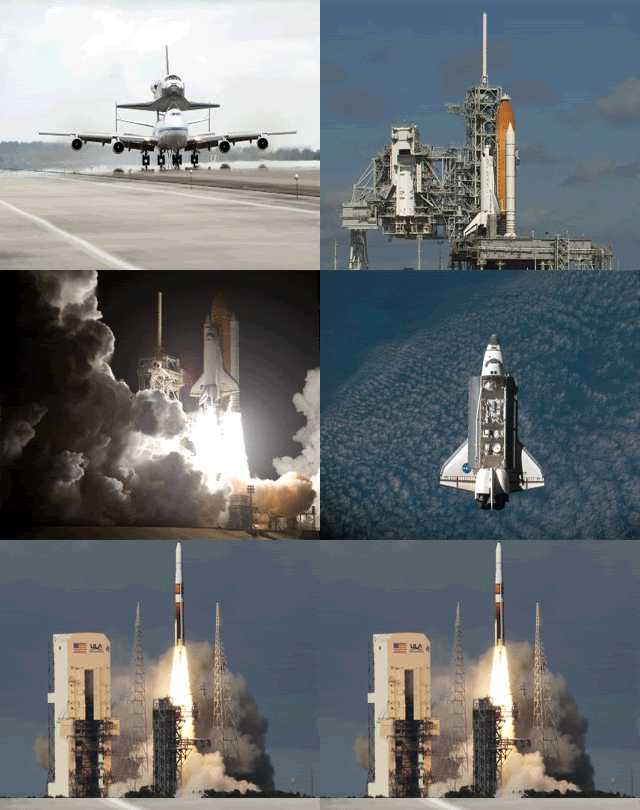
NASA's space shuttle program may be coming to an end later this year, but the agency's fleet of orbiters is preparing to celebrate an important milestone next week – the 30th anniversary of the very first space shuttle flight. On April 12, 1981, the shuttle Columbia blasted off from NASA's Kennedy Space Center in Cape Canaveral, Fla.,on the program's inaugural STS-1 mission. Thirty years later, the workhorse shuttles have played an instrumental role in constructing the International Space Station, launching critical satellites and observatories into orbit including the prolific Hubble Space Telescope and carrying numerous supplies and science experiments into space.

Over the course of his career, Wayne Hale, NASA's former space shuttle program manager, bore witness to many of these crowning achievements. Hale joined NASA in 1978 as a propulsion officer at the Johnson Space Center in Houston. He then worked as a flight director in Mission Control, presiding over 40 shuttle flights before becoming manager of the program in 2005. Hale played a critical role in the agency's recovery from the catastrophic loss in 2003 of the shuttle Columbia and its seven-astronaut crew. He now serves as Director of Human Spaceflight Programs at Special Aerospace Services, located in Boulder, Colo.


Wednesday, April 06, 2011

Russian Spaceship 'Gagarin' Arrives at Space Station

A Russian spaceship bearing the name of history's most famous cosmonaut docked at the International Space Station late Wednesday to deliver three new crew members to the orbiting lab. The Soyuz TMA-21 — nicknamed "Gagarin" after Yuri Gagarin, who became the first person in space on April 12, 1961 — successfully docked with the station's Poisk module at 7:09 p.m. EDT (2309 GMT). The spacecraft had launched from Baikonur Cosmodrome in Kazakhstan on April 4, blasting off from the same pad used for Gagarin's historic flight nearly 50 years ago. "Contact and capture — docking confirmed," a NASA official announced as the "Gagarin" sidled up to the orbiting lab. The "Gagarin" launched into space Monday (April 4 EDT) carrying two cosmonauts and one NASA astronaut to join three other crewmembers already aboard the station, rounding out the orbiting lab's Expedition 27.

The three spaceflyers — NASA's Ron Garan and Russians Alexander Samokutyaev and Andrey Borisenko — will also stay on as part of the next station mission, Expedition 28. "It was a great couple of days and we're ready to get to work," Garan said. Garan and Samokutyaev will be flight engineers on both expeditions. Borisenko will serve as a flight engineer on Expedition 27 and later serve as the commander of Expedition 28. [Vote Now! The Best Spaceships of All Time]. The crew received a flood of congratulatory calls from Russia's Mission Control center near Moscow after docking at the space station. Russian space official and the families of the astronaut and cosmonauts were on hand to wish the crew well. "We love you," Garan's wife Carmel told her husband and his crewmates after their arrival on the station. "We'll keep the fires burning at home, and we'll welcome you home with open arms at the end of your successful mission."

Tuesday, April 05, 2011

Company planning biggest rocket since man on moon


A high-tech entrepreneur unveiled plans Tuesday to launch the world's most powerful rocket since man went to the moon. Space Exploration Technology has already sent the first private rocket and capsule into Earth's orbit as a commercial venture. It is now planning a rocket that could lift twice as much cargo into orbit as the soon-to-be-retired space shuttle. The first launch is slotted for 2013 from California with follow-up launches from Cape Canaveral in Florida.

Space X's new rocket called Falcon Heavy is big enough to send cargo or even people out of Earth's orbit to the moon, an asteroid or Mars. Only the long retired Saturn V rocket that sent men to the moon was bigger. "This is a rocket of truly huge scale," said Space X president Elon Musk, who also founded PayPal and manufactures electric sports cars. The Falcon Heavy could put 117,000 pounds into the same orbit as the International Space Station. The space shuttle hauls about 54,000 pounds into orbit. The old Saturn V could carry more than 400,000 pounds of cargo.