Wednesday, March 31, 2010

Soyuz TMA-18 is Rolled Out to the Launch Pad


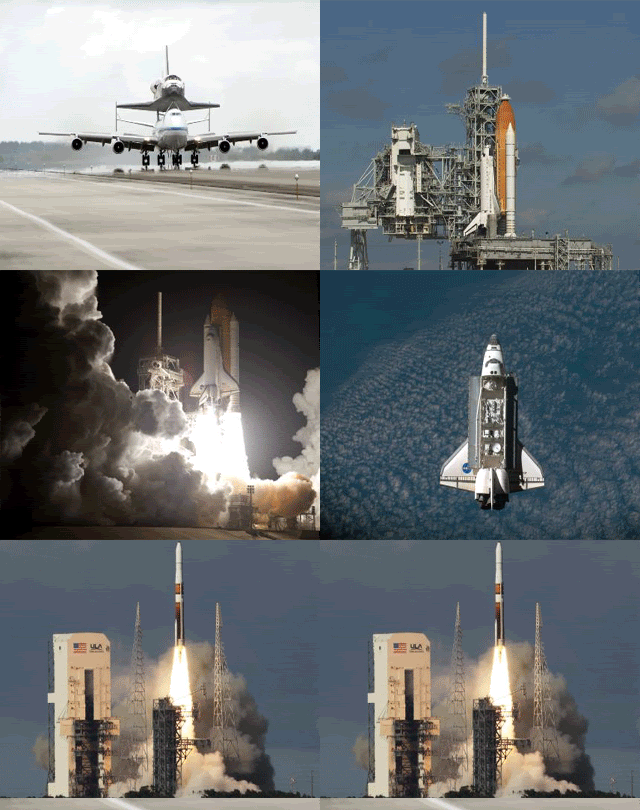
The Soyuz TMA-18 spacecraft is rolled out by train to the launch pad at the Baikonur Cosmodrome, Kazakhstan, March 31, 2010. The launch of the Soyuz spacecraft with Russian cosmonauts Alexander Skvortsov, Soyuz commander and Expedition 23 flight engineer, and Mikhail Kornienko, flight engineer; along with NASA astronaut Tracy Caldwell Dyson, flight engineer, is scheduled for 10:04 a.m., April 2, 2010 (Kazakhstan time)

Monday, March 29, 2010

Saturn's small inner moon Mimas

The highest-resolution-yet temperature map and images of Saturn's icy moon Mimas obtained by NASA's Cassini spacecraft reveal surprising patterns on the surface of the small moon, including unexpected hot regions that resemble "Pac-Man" eating a dot, and striking bands of light and dark in crater walls.

"Other moons usually grab the spotlight, but it turns out Mimas is more bizarre than we thought it was," said Linda Spilker, Cassini project scientist at NASA's Jet Propulsion Laboratory in Pasadena, Calif. "It has certainly given us some new puzzles."

Cassini collected the data on Feb. 13, during its closest flyby of the moon, which is marked by an enormous scar called Herschel Crater and resembles the Death Star from "Star Wars."

Scientists working with the composite infrared spectrometer, which mapped Mimas' temperatures, expected smoothly varying temperatures peaking in the early afternoon near the equator. Instead, the warmest region was in the morning, along one edge of the moon's disk, making a sharply defined Pac-Man shape, with temperatures around 92 Kelvin (minus 294 degrees Fahrenheit). The rest of the moon was much colder, around 77 Kelvin (minus 320 degrees Fahrenheit). A smaller warm spot - the dot in Pac-Man's mouth - showed up around Herschel, with a temperature around 84 Kelvin (minus 310 degrees Fahrenheit).

The warm spot around Herschel makes sense because tall crater walls (about 5 kilometers, or 3 miles, high) can trap heat inside the crater. But scientists were completely baffled by the sharp, V-shaped pattern.

Monday, March 22, 2010

Shuttle Detector at Heart of Volcano Alert System

As Tim Griffin and his team were working on better ways to detect hazardous gases on the shuttle launch pad, they found out they also could build something to find hazardous gases venting from a volcano.

That means they may be only a short time away from building an early warning system for volcano eruptions -- a system that could give those near an active cone days or more to evacuate to safety.
Tim Griffin works with the mobile leak detector in the back seat of a Costa Rican airplane before a sampling fllight. The shuttle leak detection system used at the launch pads is the size of three refrigerators, but Griffin's team reduced it in size and added automation so it could be mobile.Photo courtesy of Tim Griffin.

Friday, March 19, 2010

NASA’s International Space Station Program Wins Aviation Week Laureate Award

The International Space Station Program has received the 2010 Aviation Week Space Laureate Award. This year’s winners were recognized for extraordinary accomplishments in the aerospace and defense industries.

In announcing the Space Laureate award, Aviation Week noted that the space station, currently orbiting 220 miles above the Earth with a multicultural crew of three on board, is “essentially complete after 25 years of political upheavals, redesigns, technical problems and the loss of the space shuttle Columbia.

“In 2009, the final major pressurized modules were attached to the orbiting laboratory, and its life support and other systems upgraded to support a full-time crew as large as six,” the announcement continued. “The five partner agencies are working to win funding to operate the station until 2020, and engineers already are recertifying its structure until 2028. It has become the model for international cooperation on future human exploration deeper into the Solar System.”

Tuesday, March 16, 2010

Jupiter's Storms: Temperatures and Cloud Colors

New thermal images from powerful ground-based telescopes show swirls of warmer air and cooler regions never seen before within Jupiter's Great Red Spot. The images enable scientists to make the first detailed weather map of the inside of the giant storm system.

One observation illustrated by this image is the correspondence between a warm core within an otherwise cold storm system and the reddest color of the Great Red Spot.

The image on the left was obtained by the European Southern Observatory's Very Large Telescope in Chile on May 18, 2008. It was taken in the infrared wavelength range of 10.8 microns, which is sensitive to Jupiter's atmospheric temperatures in the 300 to 600 millibar pressure range.

That pressure range is close to the altitude of the white, red and brown aerosols seen in the visible-light image on the right, which was obtained by the Hubble Space Telescope on May 15, 2008. These images show the interaction of three of Jupiter's largest storms -- the Great Red Spot and two smaller storms nicknamed Oval BA and Little Red Spot.

Friday, March 12, 2010

Solar 'Conveyor Belt' Predicts Increased Sunspot Activity


Solar physicist David Hathaway of NASA's Marshall Space flight Center in Huntsville, AL and graduate student Lisa Rightmire of the University of Memphis, TN have been monitoring the sun using the Solar and Heliospheric Observatory (SOHO). They observe a massive circulating current of fire (hot plasma) within the sun operating at a faster pace as reported in the March 12th issue of Science.

The current of fire is a conveyor belt-like system called the Meridional Flow which rises to the surface at the sun's equator and spreads out toward the poles where it sinks back into the sun. "Normally it reaches peak speeds of about 20 mph," says Hathaway. "However, in 2004 the speed increased to nearly 30 mph and has remained that fast since."

The faster pace is a revelation because it occurred during the deepest solar minimum in almost 100 years and indications that the next solar cycle will be a weak one. This contradicts some theories that say a fast pace results in increased sunspot production. But it agrees with others that say a fast pace results in decreased sunspot production.

The faster rate of currents on the sun and the expected weaker solar cycle have affects for those of us here on Earth. One affect is the temperature increase of the Earth could slow down, there would be fewer auroras, and to the extent that we depend on satellites, GPS, and cell phones there should be less disruption in service.

Thursday, March 11, 2010

Robotics and Departure Preparations for Crew

Expedition 22 Flight Engineer Soichi Noguchi works at a robotic workstation in the Kibo laboratory of the International Space Station.

The Expedition 22 crew members aboard the International Space Station were busy Thursday with robotics activities and preparations for upcoming spacecraft departures.

Flight Engineers Soichi Noguchi and T.J. Creamer performed a series of checkouts and calibrations on the Kibo laboratory’s newest robotic arm, known as the small fine arm. Once its deployment is complete, the small fine arm will be used on the end of the laboratory’s larger main arm to move small science experiments and pieces of hardware on the Kibo Exposed Facility.

Creamer also had time to work with the 3D Space experiment, which involves distance, writing and illusion exercises designed to test the hypothesis that altered visual perception affects motor control.

Flight Engineer Oleg Kotov packed and transferred unneeded items into ISS Progress 35, which is scheduled to be undocked for a destructive re-entry into Earth’s atmosphere next month. He also had time to conduct a variety of scheduled maintenance activities in the Russian segment of the station.

Commander Jeff Williams and Flight Engineer Maxim Suraev packed items and made preparations for their departure from the station next week. They are scheduled to undock in the Soyuz TMA-16 spacecraft at 4:03 a.m. EDT March 18, with a landing about 3.5 hours later.

Kotov, Creamer and Noguchi will remain on the station to become the Expedition 23 crew, with Kotov taking over as station commander. New crew members Alexander Skvortsov, Tracy Caldwell Dyson and Mikhail Kornienko will launch aboard the Soyuz TMA-18 from the Baikonur Cosmodrome in Kazakhstan on April 2.

Tuesday, March 09, 2010

Herschel Finds Possible Life-Enabling Molecules in Space

Data, called a spectrum, showing water and organics in the Orion nebula. The data were taken by the heterodyne instrument for the far infrared, or HIFI, onboard the Herschel Space Observatory, a European Space Agency-led mission with important participation from NASA.

The Herschel Space Observatory has revealed the chemical fingerprints of potentially life-enabling organic molecules in the Orion nebula, a nearby stellar nursery in our Milky Way galaxy. Herschel is led by the European Space Agency with important participation from NASA.

The new data, obtained with the telescope's heterodyne instrument for the far infrared -- one of Herschel's three innovative instruments -- demonstrates the gold mine of information that Herschel will provide on how organic molecules form in space.

The Orion nebula is known to be one of the most prolific chemical factories in space, although the full extent of its chemistry and the pathways for molecule formation are not well understood. By sifting through the pattern of spikes in the new data, called a spectrum, astronomers have identified a few common molecules that are precursors to life-enabling molecules, including water, carbon monoxide, formaldehyde, methanol, dimethyl ether, hydrogen cyanide, sulfur oxide and sulfur dioxide.

Herschel is a European Space Agency cornerstone mission, with science instruments provided by a consortia of European institutes and with important participation by NASA. NASA's Herschel Project Office is based at NASA's Jet Propulsion Laboratory, Pasadena, Calif. JPL contributed mission-enabling technology for two of Herschel's three science instruments. The NASA Herschel Science Center, part of the Infrared Processing and Analysis Center at the California Institute of Technology in Pasadena, supports the United States astronomical community. Caltech manages JPL for NASA.

Monday, March 08, 2010

Mission Preparations in Full Swing


Mon, 08 Mar 2010 07:30:59 PM GMT+0530

Preparations for STS-131, the next mission to the International Space Station, continue today at NASA's Kennedy Space Center in Florida as technicians working on space shuttle Discovery at Launch Pad 39A calibrate the inertial measurement unit and test the camera located on the external fuel tank.

At NASA's Johnson Space Center in Houston, Mission Specialists Rick Mastracchio and Clayton Anderson are rehearsing procedures for their first spacewalk of the mission in the Neutral Buoyancy Lab. The lab, which resembles a huge swimming pool, simulates as closely as possible on Earth the conditions the astronauts encounter working in the weightlessness of space.

Wednesday, March 03, 2010

NASA’s International Space Station Program Wins Collier Trophy

The International Space Station is featured in this image photographed by an STS-130 crew member on space shuttle Endeavour after the station and shuttle began their post-undocking relative separation.

The International Space Station Program has won the 2009 Collier Trophy, which is considered the top award in aviation. The National Aeronautic Association bestows the award annually to recognize the greatest achievement in aeronautics or astronautics in America. “We are honored to receive this prestigious award,” said Bill Gerstenmaier, associate administrator for NASA’s Space Operations Mission Directorate. “We're proud of our past achievements to build and operate the space station, and we're excited about the future- there's a new era ahead of potential groundbreaking scientific research aboard the station."

The International Space Station is a joint project of five space agencies and 15 countries that is nearing completion and will mark the 10th anniversary of a continuous human presence in orbit later this year. The largest and most complicated spacecraft ever built, the space station is an international, technological and political achievement that represents the latest step in humankind’s quest to explore and live in space.

Designated as a national laboratory by Congress in the 2005 NASA Authorization Act, the space station provides a research platform that takes advantage of the microgravity conditions 220 miles above the Earth’s surface across a wide variety of fields, including human life sciences, biological science, human physiology, physical and materials science, and Earth and space science.
Upon completion of assembly later this year, the station’s crew and its U.S., European, Japanese and Russian laboratory facilities will expand the pace of space-based research to unprecedented levels.

Nearly 150 experiments are currently under way on the station, and more than 400 experiments have been conducted since research began nine years ago. These experiments already are leading to advances in the fight against food poisoning, new methods for delivering medicine to cancer cells and the development of more capable engines and materials for use on Earth and in space.

Thursday, February 18, 2010

NASA's Chandra Reveals Origin of Key Cosmic Explosions

New findings from NASA's Chandra X-ray Observatory have provided a major advance in understanding a type of supernova critical for studying the dark energy that astronomers think pervades the universe. The results show mergers of two dense stellar remnants are the likely cause of many of the supernovae that have been used to measure the accelerated expansion of the universe.

These supernovae, called Type 1a, serve as cosmic mile markers to measure expansion of the universe because they can be seen at large distances, and they follow a reliable pattern of brightness. However, until now, scientists have been unsure what actually causes the explosions.

"These are such critical objects in understanding the universe," said Marat Gilfanov of the Max PlanckInstitute for Astrophysics in Germany and lead author of the study that appears in the Feb. 18 edition of the journal Nature. "It was a major embarrassment that we did not know how they worked. Now we are beginning to understand what lights the fuse of these explosions."

Thursday, February 11, 2010

Perspective View of Layered Mound in Gale Crater, Mars

This oblique view shows geological layers of rock exposed on a mound inside Gale Crater on Mars. This is a lower portion of the mound, with the crater floor at the left (and lowest) edge of the image. Layers near the bottom of the mound contain clay and sulfate minerals that indicate wet conditions. Overlying rock layers contain sulfates with little or no clay, consistent with these layers forming in an environment in which water was evaporating and Mars was drying out.

This view was created from a three-dimensional topographic model of the mound. The U.S. Geological Survey generated the model from a stereo pair of images taken by the High Resolution Imaging Science Experiment (HiRISE) camera on NASA's Mars Reconnaissance Orbiter. Observations of the site by the Compact Reconnaissance Imaging Spectrometer for Mars, on the same orbiter, yielded information about composition. The vertical dimension is exaggerated three-fold relative to the horizontal dimensions. The view is toward the southeast. The width of the area included in the image is about 1.5 kilometers (about 5,000 feet). The scale bar in the labeled version is 200 meters (656 feet).

Monday, February 08, 2010

Radar Studies Continue in Hispaniola

NASA radar imaging flights over Central America, Haiti and the Dominican Republic are in the second week of a three-week campaign.

The JPL-developed Uninhabited Aerial Vehicle Synthetic Aperture Radar (UAVSAR) is currently in the second week of a three-week campaign in Central America, Haiti and the Dominican Republic. Flying beneath the belly of a modified Gulfstream III aircraft from NASA’s Dryden Flight Research Center, the sophisticated radar can spot minute changes in Earth's surface by flying precise repeat passes over targeted areas.

The Central American survey flights are focusing on measuring biomass in Central American rain forests, imaging volcanoes from Guatemala to Costa Rica, and imaging Mayan ruins. The flights over Haiti and the Dominican Republic are targeting earthquake faults on the island of Hispaniola. Scientists collected data over Central American nations again on Feb. 2, and then flew a second set of data tracks over Haiti on Feb. 3 before returning to Costa Rica on Feb. 4.

Wednesday, February 03, 2010

Envisioning Future Flight

Today's students will be designing tomorrow's aircraft, and NASA's Fundamental Aeronautics Student Competition gives them a head start.

Each year, the competition challenges students to research a particular real-world issue in aeronautics and to develop their own solutions to the problem.

Past participants in NASA's Fundamental Aeronautics Student Competition said the experience was a rewarding one that helped them learn more about aeronautics and encouraged them to improve their approaches to research and creative problem-solving.

In the 2008-2009 competition, students were challenged to develop ideas for making commercial supersonic air transportation available by 2020. Contest participants did so by examining obstacles to supersonic transportation and proposing solutions. In an additional challenge, some students submitted designs for a small supersonic airliner.

Thursday, January 28, 2010

Cassini's Next Look at Titan

Sixteen days after last visiting Saturn's largest moon, NASA's Cassini spacecraft returns for another look-see of the cloud-shrouded moon - this time from on high. The flyby on Thursday, Jan. 28, referred to as "T-66" in the hollowed halls of Cassini operations, will place the spacecraft within 7,490 kilometers (4,654 miles) above the surface during time of closest approach.

While this latest close approach places Cassini more than 6,400 kilometers (3,970 miles) higher above Titan's surface than the Jan. 12 flyby, it should not considered of lesser scientific value. Instead, this high-altitude encounter will provide an opportunity for some of the spacecraft's instruments to gain another unique perspective on this crepuscular world.

Monday, January 25, 2010

First of Many Asteroid Finds

The red dot at the center of this image is the first near-Earth asteroid discovered by NASA's Wide-Field Infrared Survey Explorer, or WISE -- an all-sky mapping infrared mission designed to see all sorts of cosmic objects.

Near-Earth objects are asteroids and comets with orbits that come close to Earth's path around the sun. This particular asteroid, called 2010 AB78, is roughly one kilometer (0.6 miles) in diameter, and is currently about 158 million kilometers (98 million miles) away from Earth. Its elliptical-shaped orbit takes it out beyond Mars and back in about as close to the sun as Earth. Because the asteroid's orbit is tilted relative to the plane of our solar system, astronomers do not think it poses a hazard to our planet. As with all near-Earth objects, 2010 AB78 will continue to be monitored.

The image shows three infrared wavelengths, with red representing the longest wavelength of 12 microns, and green and blue showing 4.6- and 3.4-micron light, respectively. The asteroid appears redder than the rest of the background stars because it is cooler and emits most of its light at longer infrared wavelengths. In visible light, this space rock is very faint and difficult to see.

WISE, which began its all-sky survey on Jan. 14, 2010, is expected to find about one hundred thousand previously undiscovered asteroids in the Main Belt between Mars and Jupiter, and hundreds of new near-Earth asteroids. It will also spot millions of new stars and galaxies.

Thursday, January 21, 2010

Rover Gives NASA an "Opportunity" to View Interior of Mars

NASA's Mars Exploration Rover Opportunity examined a rock called "Marquette Island" from mid-November 2009 until mid-January 2010. Studies of texture and composition suggest that this rock, not much bigger than a basketball, originated deep inside the Martian crust. A crater-digging impact could have excavated the rock and thrown it a long distance, to where Opportunity found it along the rover's long trek across the Meridiani plain toward Endeavour Crater.

This approximately true-color view of Marquette Island comes from combining three exposures that Opportunity's panoramic camera (Pancam) took through different filters during the rover's 2,117th Martian day, or sol, on Mars (Jan. 6, 2010). On the preceding sol, Opportunity's rock abrasion tool brushed dust out of the circular area where that tool had ground into the rock on sols 2100 and 2103 (Dec. 20 and 23, 2009). The dark circle left by the rock abrasion tool's work is approximately 5 centimeters (2 inches) in diameter.

Second Warmest Year on Record; End of Warmest Decade

2009 was tied for the second warmest year in the modern record, a new NASA analysis of global surface temperature shows. The analysis, conducted by the Goddard Institute for Space Studies (GISS) in New York City, also shows that in the Southern Hemisphere, 2009 was the warmest year since modern records began in 1880.

Although 2008 was the coolest year of the decade -- due to strong cooling of the tropical Pacific Ocean -- 2009 saw a return to near-record global temperatures. The past year was only a fraction of a degree cooler than 2005, the warmest year on record, and tied with a cluster of other years --1998, 2002, 2003, 2006 and 2007 1998 and 2007 -- as the second warmest year since recordkeeping began.

“There’s always an interest in the annual temperature numbers and on a given year’s ranking, but usually that misses the point,” said James Hansen, the director of GISS. “There's substantial year-to-year variability of global temperature caused by the tropical El Niño-La Niña cycle. But when we average temperature over five or ten years to minimize that variability, we find that global warming is continuing unabated."

Monday, January 18, 2010

Endeavour's STS-130 Mission


Commander George Zamka will lead the STS-130 mission to the International Space Station aboard space shuttle Endeavour. Terry Virts will serve as the pilot. Mission Specialists are Nicholas Patrick, Robert Behnken, Stephen Robinson and Kathryn Hire. Virts will be making his first trip to space.

Shuttle Endeavour and its crew will deliver to the space station a third connecting module, the Italian-built Tranquility node and the seven-windowed cupola, which will be used as a control room for robotics. The mission will feature three spacewalks.

Liftoff from NASA's Kennedy Space Center in Florida is targeted for February 7, 2010, at 4:39 a.m. EST

Tuesday, January 12, 2010

Solar Scientists Use 'Magnetic Mirror Effect' to Reproduce IBEX Observation


Ever since NASA's Interstellar Boundary Explorer, or IBEX, mission scientists released the first comprehensive sky map of our solar system's edge in particles, solar physicists have been busy revising their models to account for the discovery of a narrow "ribbon" of bright emission that was completely unexpected and not predicted by any model at the time.

Further study by a team of scientists funded through NASA's Heliophysics Guest Investigator program has produced a revised model that explains and closely reproduces the IBEX result by incorporating a single new effect into an existing model. The new effect, put forward by the IBEX team soon after sighting of the ribbon, is that the magnetic field surrounding our solar system—called the local galactic magnetic field—acts like a mirror for the particles that IBEX sees.