Showing posts with label Space Telescope. Show all posts

Wednesday, November 10, 2010

Space Shuttle STS-133


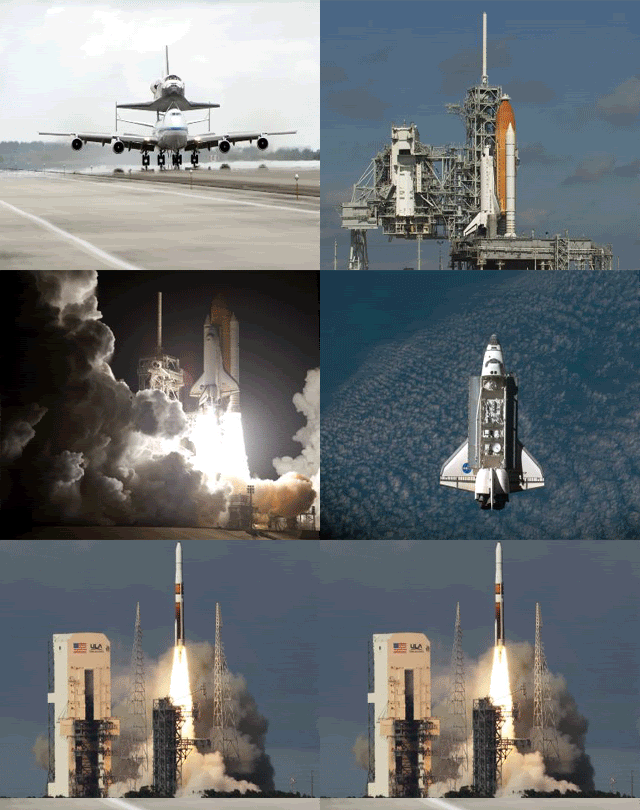
During space shuttle Discovery's final spaceflight, the STS-133 crew members will take important spare parts to the International Space Station along with the Express Logistics Carrier-4. Discovery has been moved to Launch Pad 39A at NASA's Kennedy Space Center in Florida.

Wednesday, October 06, 2010

MAVEN Mission to Investigate How Sun Steals Martian Atmosphere


The Red Planet bleeds. Not blood, but its atmosphere, slowly trickling away to space. The culprit is our sun, which is using its own breath, the solar wind, and its radiation to rob Mars of its air. The crime may have condemned the planet's surface, once apparently promising for life, to a cold and sterile existence.

Features on Mars resembling dry riverbeds, and the discovery of minerals that form in the presence of water, indicate that Mars once had a thicker atmosphere and was warm enough for liquid water to flow on the surface. However, somehow that thick atmosphere got lost in space. It appears Mars has been cold and dry for billions of years, with an atmosphere so thin, any liquid water on the surface quickly boils away while the sun's ultraviolet radiation scours the ground.

Tuesday, September 14, 2010

Chandra Finds Evidence for Stellar Cannibalism


The composite image on the left shows X-ray and optical data for BP Piscium (BP Psc), a more evolved version of our Sun about 1,000 light years from Earth. Chandra X-ray Observatory data are colored in purple, and optical data from the 3-meter Shane telescope at Lick Observatory are shown in orange, green and blue. BP Psc is surrounded by a dusty and gaseous disk and has a pair of jets several light years long blasting out of the system. A close-up view is shown by the artist's impression on the right. For clarity a narrow jet is shown, but the actual jet is probably much wider, extending across the inner regions of the disk. Because of the dusty disk, the star’s surface is obscured in optical and near infrared light. Therefore, the Chandra observation is the first detection of this star in any wavelength.

The disk and the jets, seen distinctly in the optical data, provide evidence for a recent and catastrophic interaction in which BP Psc consumed a nearby star or giant planet. This happened when BP Psc ran out of nuclear fuel and expanded into its "red giant" phase.

Tuesday, September 07, 2010

Crew Readies for Resupply Ship and Upcoming Departure


The Expedition 24 crew members are preparing for the arrival of the ISS Progress 39 cargo craft to replenish the orbiting laboratory with food, fuel, supplies and other cargo. The Progress 39 will dock to the aft end of the Zvezda service module Friday, Sept. 10. It is replacing the trash-filled Progress 38 which undocked Aug. 31 and is poised to re-enter Earth’s atmosphere Monday for a fiery destruction over the Pacific Ocean.

The crew also will have an off-duty day Monday due to a frenetic pace of science activities. The six crew members are relaxing after three repair spacewalks restored the station’s cooling system.

Hurricane activity captured the attention of the station residents as they photographed and videotaped Earl churning in the Atlantic Ocean. The imagery and video are downlinked to ground controllers for observation and study by scientists. A Russian experiment, Uragan (Hurricane), monitors and studies the catastrophic effects of natural and man-made disasters. Other ongoing Earth observation experiments aboard the orbiting laboratory study natural phenomena and human activities and their consequences on the planet.

Monday, August 30, 2010

Successful Ice Cloud and Land Elevation Mission


orbiting sentinels is expected to return to Earth in a few days. The agency's Ice, Cloud, and land Elevation (ICESat) satellite completed a very productive scientific mission earlier this year. NASA lowered the satellite's orbit last month and then decommissioned the spacecraft in preparation for re-entry. It is estimated that the satellite will re-enter the Earth's atmosphere and largely burn up on or about August 29.

ICESat's lasting legacy will be its impact on the understanding of ice sheet and sea ice dynamics. The mission has led to scientific advances in measuring changes in the mass of the Greenland and Antarctic ice sheets, polar sea ice thickness, vegetation-canopy heights, and the heights of clouds and aerosols. Using ICESat data, scientists identified a network of lakes beneath the Antarctic ice sheet. ICESat introduced new capabilities, technology and methods such as the measurement of sea ice freeboard – or the amount of ice and snow that protrudes above the ocean surface - for estimating sea ice thickness.

Monday, August 16, 2010

NRC's 2010 Astrophysics Decadal Survey


National Research Council's Astro2010 report, New Worlds, New Horizons in Astronomy and Astrophysics. We appreciate the science community's efforts in defining a set of compelling science objectives for space-based astrophysical research for the coming decade, and for carefully considering the cost of the initiatives the report recommends.

We look forward to assessing the report's findings and recommendations for strengthening the nation's world-class space astrophysics program. From new worlds to new physics, the coming decade of discovery leverages not only our current space observatories – such as the Hubble, Spitzer, Chandra and Fermi space telescopes – but also our planned facilities – especially those from previous decadal surveys, the James Webb Space Telescope and the Stratospheric Observatory for Infrared Astronomy (SOFIA). The survey calls for new facilities that expand our reach into the cosmos that will include opportunities for coordination and cooperation with other Federal agencies and international partners.

Tuesday, August 10, 2010

Crew to Perform Second of Three Spacewalks Wednesday

Flight controllers and engineers continue meetings to review the results from the first spacewalk conducted Saturday by International Space Station Expedition 24 Flight Engineers Doug Wheelock and Tracy Caldwell Dyson and to plan for the second of what now will be three spacewalks to complete the replacement of a failed pump module on the station’s starboard truss.

In the wake of an eight-hour, three-minute spacewalk Saturday that fell short of removing the failed pump module due to a leak in the fourth of four ammonia line connectors hooked up to the old pump, mission operations and station program officials laid out a series of procedures for Wheelock and Caldwell Dyson to perform at the beginning of the second spacewalk Wednesday designed to greatly reduce, or eliminate the possibility of ammonia leaking from the final fluid connector – called M3 – when it is demated to set the stage for the failed pump to be removed from the truss.

Wednesday, July 07, 2010

Spitzer Space Telescope

A dragon-shaped cloud of dust seems to fly with the stars in a new image from NASA's Spitzer Space Telescope . In visible light the creature disappears into the clouds perhaps it's "frolicking in the autumn mist" like Puff, the Magic Dragon, from the famous Peter, Paul and Mary song.

The infrared image has revealed that this creature, a dark cloud called M17 SWex, is forming stars at a furious rate but has not yet spawned the most massive type of stars, known as O stars.The stars and gas in this region are now passing though the Sagittarius spiral arm of the Milky Way, touching off a galactic "domino effect." It takes an infrared view to catch the light from these shrouded regions and reveal the earliest stages of star formation.

The bottom image is a three-color composite that shows infrared observations from two Spitzer instruments. Blue represents 3.6-micron light and green shows light of 8 microns, both captured by Spitzer's infrared array camera. Red is 24-micron light detected by Spitzer's multiband imaging photometer. The bottom visible light image is a composite of visible-light data from the Digitized Sky Survey from the UK Schmidt telescope. The image combines two observations that represent the blue and red light from the region.