Tuesday, October 27, 2009

NASA's Ares 1-X Rocket Waits...

NASA's Ares 1-X rocket, intended as part of the replacement for its aging space shuttles, sat patiently on the launch pad today, waiting for its first test flight.

It went nowhere. Controllers finally scrubbed the launch for today after waiting more than three hours for acceptable weather. They worried that the rocket, rising through Florida storm clouds, might generate dangerous amounts of static electricity as it climbed into the sky.

"We're not going to be go for today," said one controller over a radio loop. "You gave it a good shot," came the answer. They decided to try again for Wednesday morning -- though, as launch control's voice, George Diller, put it, "The weather for tomorrow is better but not great."

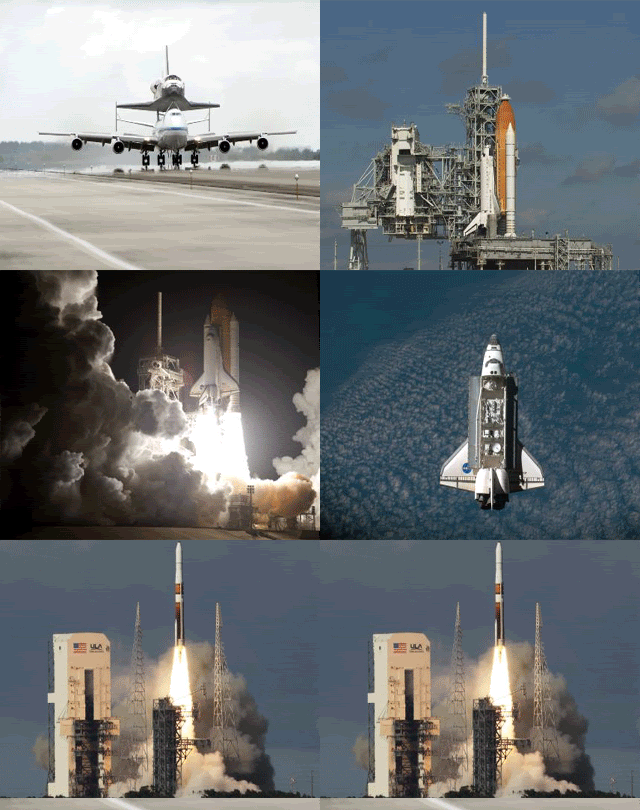
NASA set modest goals for this first test flight. The Ares' first stage, firing for two minutes, would only lift the rocket about 30 miles over the Atlantic ocean. The rest of the rocket, including its bulbous second stage, was made of mockup parts. It was a comedy of errors this morning, as the 300-foot-tall rocket sat on pad 39B at the Kennedy Space Center in Florida, waiting to go.

Launch was originally scheduled for 8:00 a.m. ET, but that time came and went when a protective cover on the nose of the rocket wouldn't come off. They reset the clock for 8:30 a.m., then 9:24, then 9:44, then 9:54, then 10:54, then 11:04, then 11:19, but clouds, or winds, or a passing cargo ship near the oceanside launch pad got in the way each time.

Son of Shuttle

The one thing that appeared to be working properly was the rocket itself -- no surprise, since, in fact, it's an updated version of the solid rocket boosters one sees strapped to each side of a space shuttle's orange fuel tank. The boosters have been used since 1981. One failed, tragically, causing the Challenger explosion in 1986, but they have been heavily modified since then.

The Ares rocket, standing pencil-thin on the launch pad, was meant to be simpler, cheaper and more reliable than the shuttles. If it ever carries astronauts, they will be in a squat cone-shape Orion capsule on top of the rocket -- considered safer than the shuttles, which are attached to the side of their external tanks, and have often been hit by debris falling from the tanks during launch. The 2003 Columbia tragedy was believed caused by foam from the fuel tank, coming off and damaging the shuttle's wing.

Monday, October 26, 2009

Ares I-X GO For Launch on October 27th

Often, in the readiness review prior to any launch, there are several open items, “I-forgots,” or other work still left to do before a mission is given a go-ahead for launch. Today, the Ares I-X had nearly every box checked. The Ares I-X team has certainly done its homework, and what little remains can be completed in the next couple of days before launch.

Generally speaking, technical issues can hold up a flight readiness review. If the hardware or software isn’t working, the launch could be delayed until the problem is fixed. However for I-X there was nothing to talk about. No technical problems are affecting the mission. Again, the team has done its work and because of that, we got a relatively trouble-free readiness review.

The only remaining question mark is the weather, which is still touch and go right now. Forecasts are predicting a 40% chance of favorable weather on Tuesday.

But the hard parts—the things NASA can do something about—are all good to go.

Saturday, October 24, 2009

Rocket reactions

For every action there is an equal and opposite reaction: That law applies to rocket science, and apparently to an independent review panel's report on NASA's rocket options as well.

The reactions to this week's full 155-page report on the future of NASA's human spaceflight were swift, and set forth opposite conclusions: On one hand, some members of Congress cast the report as an endorsement of NASA's current return-to-the-moon plan (running counter to the more widespread interpretation). Other members, meanwhile, blasted the report essentially because it wasn't an endorsement.

Although the focus of the report was to lay out the big picture for America's space effort, the political debate will more likely focus on one aspect of that picture: what to do about NASA's Ares I rocket. A prototype for that rocket is due for its first test launch on Tuesday, but the report is already sparking suggestions that the launch and any other work on the Ares I might be wasted effort.

Those are fighting words for the folks who have worked so hard over the past few years to get Ares this far - including the program's supporters in Congress. Between now and next February, the White House will have to decide whether to stay the course with Ares, potentially adding billions of dollars to the program's budget, or go another way.

The alternatives include adding enhancements to existing heavy-lift commercial launchers such as the Delta 4 and Atlas 5 (including sensors and an escape system for a spacecraft's crew), or relying on yet-to-be-tested launchers such as Space X's Falcon 9 and Orbital's Taurus 2, or going back to square one and redesigning a shuttle-derived launcher, or a combination of those options.

Stay the course, or change course? NBC News' Cape Canaveral correspondent, Jay Barbree, states the case for sticking with Ares. NBC News space analyst Jim Oberg, in contrast, likes the idea of low-cost commercial space taxis for trips to low Earth orbit.

Although the next move is up to the White House, it's clear that Congress intends to weigh in - and it would be a mistake not to take that into account. Alan Ladwig, NASA's deputy associate administrator for public liaison, recalls that a previous panel headed by aerospace executive Norman Augustine laid out a vision for NASA exploration back in 1990 - but that the vision went nowhere because Congress wasn't on board.

"I think if they do that again, it's dead on arrival," Ladwig said this week at the International Symposium for Personal and Commercial Spaceflight.

Friday, October 23, 2009

International Space Station

To get to the moon and then eventually go on to Mars will take much more money and technology than the U.S. space program has now, according to a report released today by an independent panel convened, at White House request, under former aerospace executive Norman Augustine.

Retire the space shuttle as planned in 2010 or 2011.

Extend the life of the International Space Station until 2020. NASA had planned to ditch the station -- which is still not finished -- in the Pacific Ocean in 2015 so it would have more money for its new fleet of ships, the Orion space capsule and its Ares booster.

Keep Ares and Orion going -- but recognize they probably won't be ready for regular use until 2017. They were originally expected to be operational in 2012. The panel said it might be an option to scrap the Ares 1 booster, and use other rockets instead.

Encourage commercial space development to fill in the gap between the shuttle and the next generation of ships. To do all this, the panel said NASA would need substantially more funding -- an additional $3 billion annually starting next year.

In its 157-page report, the 10-member Augustine panel encouraged NASA to think beyond low Earth orbit, which is where astronauts have been limited since the end of the Apollo moon flights nearly 40 years ago. But they urged revisions in America's space ambitions.

"Mars is the ultimate destination for human exploration of the inner solar system, but it is not the best first destination," they wrote. "What about the moon first, then Mars? By first exploring the moon, we could develop the operational skills and technology for landing on, launching from and working on a planetary surface. In the process, we could acquire an understanding of human adaptation to another world that would one day allow us to go to Mars.

"There are two main strategies for exploring the moon. Both begin with a few short sorties to various sites to scout the region and validate lunar landing and ascent systems."

But the panel said a Mars mission is not yet possible with current technology, and there may be simpler missions -- such as flights to near-earth asteroids or perhaps Mars' two small moons, that could be accomplished first.

Thursday, October 22, 2009

Ares I-X Launch Preparations

Technicians at Kennedy Space Center's Launch Pad 39B continue preparing the Ares I-X test launch vehicle for its targeted liftoff on Oct. 27.

Today, the rocket will undergo full testing, including a "hot fire" of the auxiliary power units as part of the integrated systems test. The rotating service structure will be opened midday today and moved back into place after an evening test of the Xenon lights is completed tomorrow night.

Also tomorrow, the Ares I-X Flight Test Readiness Review will be held at Kennedy, which is expected to include the selection of an official launch date. At the launch pad, technicians will test the launch pad and ground systems, and ground support equipment.

A launch countdown simulation is set for Saturday, with vehicle closeouts scheduled for Sunday.

NASA's first flight test for the agency's next-generation spacecraft and launch vehicle system, called Ares I-X, will bring NASA one step closer to its exploration goals. The flight test will provide NASA with an early opportunity to test and prove flight characteristics, hardware, facilities and ground operations associated with the Ares I.

Wednesday, October 21, 2009

Organic Molecules Around Gas Planet

The basic chemistry for life has been detected in a second hot gas planet, HD 209458b, depicted in this artist's concept. Two of NASA's Great Observatories – the Hubble Space Telescope and Spitzer Space Telescope, yielded spectral observations that revealed molecules of carbon dioxide, methane and water vapor in the planet's atmosphere. HD 209458b, bigger than Jupiter, occupies a tight, 3.5-day orbit around a sun-like star about 150 light years away in the constellation Pegasus. Planets like this one,Organic Molecules Around Gas Planet which circle stars beyond our sun, are called exoplanets.


The new finding follows the detection of these same organic molecules in the atmosphere of another hot, giant planet, called HD 189733b, by astronomers using Hubble and Spitzer data. Astronomers can now begin comparing the chemistry and dynamics of these two planets, and search for similar measurements of other candidate exoplanets, advancing toward the goal of being able to characterize planets where life could exist.

Neither of the two planets studied is habitable, but they display the same molecules that, if found around a rocky planet in the future, could potentially indicate the presence of life.

The new findings pave the way for future work that will help astronomers shortlist any promising rocky Earth-like planets where the signatures of organic chemicals might indicate the presence of life.

Tuesday, October 20, 2009

Nasa's rocket roll-out complete

The US space agency's Ares 1-X test rocket has reached its launch pad at Florida's Kennedy Space Center. The launcher's journey from its assembly building to the pad took nearly eight hours.

The super-slim, 100m-tall launcher is a demonstrator for the vehicle Nasa plans to use in the next decade to take its new astronaut crewship into orbit. The Ares I-X is expected to make an unmanned, two-minute flight at the end of the month.

This is designed to check out basic design concepts and gather engineering data. However, the project's long-term future is uncertain and could conceivably be cancelled in the coming months. US President Barack Obama convened an expert panel back in May to review American human spaceflight plans and priorities.

Led by former Lockheed Martin CEO Norm Augustine, the advisory group has suggested a range of options for getting astronauts into space - most of which do not require the new stick-like Ares launcher.

The Ares 1-X started its move from the giant Vehicle Assembly Building (VAB) at the Kennedy Space Center at around 0639 BST (0139 EDT) on Tuesday. It was carried atop a huge crawler-transporter vehicle during the 6.7km (4.2 miles) journey to launch pad 39B.

The rocket is now positioned on the pad and engineers are establishing mechanical and electrical connections. Later today, a vehicle stabilisation system - to steady the rocket against high winds - and a rotating service structure will be deployed.

The $350m (£213m; 234m euro) test launch is scheduled to take place from the Florida spaceport no earlier than the 27th of the month. The 1-X will climb about 40km (25 miles) into the sky during the powered phase of its flight, continuously measuring vehicle aerodynamics, controls and performance of the rocket's first stage.

The demonstrator will help verify design assumptions so that when the Ares 1 proper is built, the engineers can be confident it will fly as expected. "It's a tall rocket; it's been over three decades since anyone has built a rocket this tall. That was the Saturn V," explained Trent Smith, the vehicle processing engineer for the Ares 1-X.

"We have over 700 sensors on this rocket; and the whole point of Ares 1-X is to understand how does a rocket this shape, this weight, this tall actually fly," he told BBC News.

The top half of the 1-X is a dummy. What would be an upper-stage, with a crew capsule and its emergency escape mechanism are simulators made to the correct shape and weight.

Once the first stage has been extinguished and has separated from the top of the 1-X, all the elements will come back to Earth.

The first-stage booster will parachute into the Atlantic Ocean where it will be recovered for inspection by engineers. The simulation elements of the vehicle will be destroyed on impact with the water.

The US space agency is scheduled to retire its space shuttles next year, and has begun the development of a new human space launch "architecture" called Constellation.

The architecture calls for two new rockets: the Ares 1 to launch crew, and a new heavy-lift rocket known as Ares 5 that could put into orbit the equipment needed by a manned capsule to travel to the Moon and beyond.

However, all the systems are under review, and many commentators expect the Ares development plans to be heavily modified or even cancelled.

If it is allowed to proceed, a manned Ares 1 is not expected to fly before 2016.

Monday, October 19, 2009

Chandrayaan’s moon findings: Water, rocks and traces of Apollo

Soon after India’s moon mission, Chandrayaan -1 was called off due to loss of signal in August this year, National Aeronautics and Space Agency (NASA) thanked Indian Space Research Organisation (ISRO) for a landmark discovery.

Chandrayaan’s moon findings: Water, rocks and traces of Apollo

A NASA instrument onboard Chandrayaan -1, revealed water molecules in amounts greater than predicted. NASA said the M3 team found water molecules and hydroxyl at diverse areas of the sunlit region of the moon's surface. The water signature appeared stronger at the moon's higher latitudes.

Water on the moon is just one of the many crucial moon findings. There are other interesting facts that Chandrayan-1 discovered on its trip to the Moon.

Here is all that India's maiden foray to Moon revealed:

I. Iron on moon

Chandrayaan-1 confirmed presence of iron in the lunar soil and, for the first time, revealed changes in rock and mineral composition. The sighting of the mineral is first in the past five years and only the second in 10 years following a US mission in 1998-99 and European mission in 2003.

II. Traces of Apollo 15

Camera on board Chandrayaan-1 recorded images of the landing site of US spacecraft Apollo 15, putting an end to conspiracy theories claiming that the fourth US mission to moon was a hoax. The terrain mapper camera onboard Chandrayaan-1 also sent the images of tracks of the lunar rovers used by astronauts to travel on lunar surface. A scientist told media that since lunar dust is dark, the disturbances left behind by the spacecraft and the rovers are easily distinguishable. Chandrayaan could not capture the images of footprint left behind by the first astronauts on moon, Neil Armstrong and Edwin Aldrin, because of resolution capability.

Thursday, October 15, 2009

Engineers Excited by EuTEF's Return on Discovery

When Fabio Tominetti and Marco Grilli last saw the EuTEF research platform in early 2008, it was carefully packed inside the payload bay of space shuttle Atlantis. It had been built and handled with the utmost care, and its white and thermal insulation and golden reflective sheets and experiments were pristine.

EuTEF didn’t look much different as it hung upside down in a work stand a few days after coming back to Earth aboard Discovery following about a year and a half attached to the orbiting International Space Station.

"It’s almost brand new," said Tominetti, the EuTEF program manager for the Milan-based Carlo Gavazzi Space. "It could probably fly again tomorrow. I expected to see something to tell you that it had been exposed to 18 months in space."

EuTEF is short for European Technology Exposure Facility, a remote-controlled base complete with power and communications networks built to host nine experiments from Europe’s scientific community, including prestigious universities and foundations. The research largely focused on the effects of space on materials, including window materials that could be used on future spacecraft.

Tominetti and Grilli, a systems engineer with Carlo Gavazzi, recently traveled to NASA's Kennedy Space Center in Florida to pack the research platform and its experiments for their return to Europe. The EuTEF went into space with the European Space Agency’s Columbus laboratory module as part of the STS-122 mission in February 2008. After Columbus was connected to the space station, spacewalking astronauts attached EuTEF to one of its platforms on the outside.


From there, the experiments would be exposed to the harshness of a constant vacuum, a round-the-clock dose of radiation, and heat and cold extremes that vary 200 degrees during each 90-minute orbit of the planet. Despite the conditions, EuTEF returned exciting early results, Tominetti said. For example, a study of atomic oxygen around the space station revealed that two computer models of the chemical’s distribution were not as accurate as they should be, but a third model was correct. Knowing where corrosive atomic oxygen molecules are and how they behave in orbit helps future spacecraft designers.

Although EuTEF delivered some results while still in space, researchers will get the chance to look at the materials samples and other experiment results firsthand once EuTEF is taken back to Europe and shipped to their sponsors.

The Space Shuttle's Gas Tank

Today there are four external tanks in the assembly line at Michoud, ET-135 thru ET-138. All of these tanks will board Pegasus in late 2009 or early 2010 and make the 900-mile trip from Michoud to Kennedy Space Center to play their vital role in supplying the Space Shuttle Main Engines with 145,000 gallons of liquid oxygen and 390,000 gallons of liquid hydrogen during the first eight-and-a-half-minutes of launch.

One additional tank resides at Michoud, but it may never fly. ET-122 was present at Michoud when Hurricane Katrina hit Louisiana in 2005 and was damaged. In fact ET-122 is now being repaired to serve as the very last tank of the Space Shuttle Program, the Launch on Need tank for the last scheduled space shuttle mission, STS-133, in the fall of 2010. If all goes well with that mission ET-122 should never fly.


fter the loss of space shuttle Columbia in February 2003, NASA went to work to redesign and improve many components of the structures of the external tanks and the application processes of the all important foam, also known as the Thermal Protection System or TPS. Major improvements have been made to the tank's forward bipod fitting area, the liquid hydrogen tank Ice Frost Ramps, the intertank flange area, and the liquid oxygen feedline brackets and bellows. The tank's protuberance air load ramps -- known as PAL ramps -- were also removed.

By the summer of 2008 external tank foam application and new designs had reduced the amount of foam being released during launch to very small, if not tiny amounts of foam. The successful reduction in foam debris came as a result of a non-stop process of continuous improvement to make shuttle launches as safe as possible, recognizing that external tanks will still release very small amounts of foam. Even with a few hiccups, the external tanks flying today are the safest and best tanks ever flown in the history of the shuttle program.

The newest tanks, including ET-134, have been welded using a new welding technology called Friction Stir Welding, a technique better than conventional fusion welding. Friction stir welding is different in that the materials are not melted. A rotating tool pin uses friction and pressure to plasticize the metal and join the two parts together.

As a result, weld joints are more efficient, yielding 80 percent of the base strength. Fusion welding averages 40 to 50 percent of the base material's strength. In fact ET-134 is the first external tank to have most of its liquid hydrogen tank welding performed by friction stir welding.

Wednesday, October 14, 2009

Space Shuttle information

Space shuttle Atlantis began its move from the Vehicle Assembly Building to Launch Pad 39A at NASA's Kennedy Space Center in Florida at 6:38 a.m. EDT. The 3.4-mile journey of the crawler-transporter with the shuttle stacked on top is expected to take about six hours.

At NASA's Johnson Space Center in Houston, the STS-129 astronauts are rehearsing orbit maneuvers today in the fixed base simulator.

The simulator mimics the dials and controls of the shuttle along with monitors that animate a view from outside the shuttle's window. Johnson technicians program the simulator's software to throw various problem situations at the crew to make sure they can cope with anything while in flight.

Meanwhile, the Space Shuttle Program's Flight Readiness Review, or FRR, is scheduled for Oct. 20 and 21. The executive-level FRR with NASA managers to set an official launch date is planned for Oct. 29 and will be held at Kennedy.

Preparations for STS-129 Mission

The STS-129 mission will be commanded by Charles O. Hobaugh and piloted by Barry E. Wilmore. Mission Specialists are Robert L. Satcher Jr., Mike Foreman, Randy Bresnik and Leland Melvin. Wilmore, Satcher and Bresnik will be making their first trips to space.

Atlantis and its crew will deliver two control moment gyroscopes, equipment and EXPRESS Logistics Carrier 1 and 2 to the International Space Station. The mission will feature three spacewalks.

Atlantis also will return station crew member Nicole Stott to Earth and is slated to be the final space shuttle crew rotation flight. Launch of Atlantis on the STS-129 mission is targeted for 4:04 p.m. EST Nov. 12.

Spacewalks undersea

The three astronauts, joined by a Constellation Program engineer and a team of diving “buddies,” are performing engineering evaluations for next spring’s NEEMO 14 mission. The NASA Extreme Environment Mission Operations 14 (NEEMO 14) was slipped from October to allow the National Oceanic and Atmospheric Administration (NOAA) to complete a safety review of its Aquarius underwater laboratory.

Aquarius, located three miles off Key Largo in the Florida Keys National Marine Sanctuary, is the world's only permanent underwater habitat and laboratory,The team of NASA divers and astronauts spent last week doing preliminary work at a Key Largo, Fla., base. This week the team will perform some engineering evaluations on a low-fidelity, full scale mock-up of the Altair lunar lander positioned next to NOAA’s lab.

The engineering tests include 1/6 g operational evaluations of unloading a mock-up of the Lunar Electric Rover off the lander platform, rover hatch size evaluations, and incapacitated crew rescue operations.

Veteran space shuttle pilot Eric Boe is leading the NASA team. Joining Boe are veteran astronauts and aquanauts Mike Gernhardt and Richard Arnold, along with Lunar Electric Rover deputy project manager Andrew Abercromby.

The rover and lander mockups rival the size of the vehicles NASA is designing for future planetary exploration. The lander mockup is wider than a school bus is long and almost three times as high, measuring 45 feet wide and 28 feet high, including a six-foot high crane. The rover mockup is slightly larger than a full-size SUV, standing eight feet tall and 14 feet long.

Boe completed his first space flight as pilot on STS-126 in November 2008 and is assigned to pilot the STS-133 mission targeted for September 2010. Gernhardt is a veteran of four space shuttle flights, four spacewalks and two NEEMO missions. Arnold completed two spacewalks during his first spaceflight, the STS-119 mission in March and he was part of the NEEMO 13 mission in August 2007.
Andrew Abercromby serves as the deputy project manager and a biomedical engineer for the Lunar Electric Rover project and deputy lead for the Exploration Analogs and Mission Development project. As part of the Human Research Program, he is a project engineer for the Extravehicular Activity Physiology, Systems and Performance project for Wyle Integrated Science and Engineering Group in Houston. He has extensive experience in planning and executing field test operations including NEEMO and NASA’s Haughton Mars Project, Desert RATS, and the Pavilion Lake Research Project.

NEEMO missions are a cooperative project among NASA, NOAA and University of North Carolina at Wilmington the university.

Tuesday, October 13, 2009

Arctic Sea Ice Extent is Third Lowest on Record

U.S. satellite measurements show Arctic sea ice extent in 2009 – the area of the Arctic Ocean covered by floating ice – was the third lowest since satellite measurements were first made in 1979. The ice area at minimum was an increase from the past two years, but still well below the average for the past 30 years.

Arctic sea ice reached its minimum extent around September 12, as shown in the image and video to the right. According to scientists affiliated with the National Snow and Ice Data Center (NSIDC), sea ice coverage dropped to 5.10 million square kilometers (1.97 million square miles) at its minimum. The ice cover was 970,000 square kilometers (370,000 square miles) greater than the record low of 2007 and 580,000 square kilometers (220,000 square miles) greater than 2008.

NSIDC is sponsored by several U.S. government agencies, including NASA. Ice data are derived from measurements made by U.S. Department of Defense and NASA satellites, with key work in interpreting the data and developing the 30-year history done by scientists at NASA's Goddard Space Flight Center in Greenbelt, Md.

"The changes from year to year are interesting since there has been large variability," said Josefino Comiso, a sea ice expert at NASA Goddard. "But we need to look at several years of data to examine the long-term trends."

Monday, October 12, 2009

Spacecraft Impacts Lunar Crater in Search for Water Ice

NASA's Lunar Crater Observation and Sensing Satellite, or LCROSS, created twin impacts on the moon's surface early Friday in a search for water ice. Scientists will analyze data from the spacecraft's instruments to assess whether water ice is present.

The satellite traveled 5.6 million miles during an historic 113-day mission that ended in the Cabeus crater, a permanently shadowed region near the moon's south pole. The spacecraft was launched June 18 as a companion mission to the Lunar Reconnaissance Orbiter from NASA's Kennedy Space Center in Florida.

"The LCROSS science instruments worked exceedingly well and returned a wealth of data that will greatly improve our understanding of our closest celestial neighbor," said Anthony Colaprete, LCROSS principal investigator and project scientist at NASA's Ames Research Center in Moffett Field, Calif. "The team is excited to dive into data."

In preparation for impact, LCROSS and its spent Centaur upper stage rocket separated about 54,000 miles above the surface of the moon on Thursday at approximately 6:50 p.m. PDT.

Moving at a speed of more than 1.5 miles per second, the Centaur hit the lunar surface shortly after 4:31 a.m. Oct. 9, creating an impact that instruments aboard LCROSS observed for approximately four minutes. LCROSS then impacted the surface at approximately 4:36 a.m.

"This is a great day for science and exploration," said Doug Cooke, associate administrator for the Exploration Systems Mission Directorate at NASA Headquarters in Washington. "The LCROSS data should prove to be an impressive addition to the tremendous leaps in knowledge about the moon that have been achieved in recent weeks. I want to congratulate the LCROSS team for their tremendous achievement in development of this low cost spacecraft and for their perseverance through a number of difficult technical and operational challenges."‪

Other observatories reported capturing both impacts. The data will be shared with the LCROSS science team for analysis. The LCROSS team expects it to take several weeks of analysis before it can make a definitive assessment of the presence or absence of water ice.

"I am very proud of the success of this LCROSS mission team," said Daniel Andrews, LCROSS project manager at Ames. "Whenever this team would hit a roadblock, it conceived a clever work-around allowing us to push forward with a successful mission."

The images and video collected by the amateur astronomer community and the public also will be used to enhance our knowledge about the moon.

"One of the early goals of the mission was to get as many people to look at the LCROSS impacts in as many ways possible, and we succeeded," said Jennifer Heldmann, Ames' coordinator of the LCROSS observation campaign. "The amount of corroborated information that can be pulled out of this one event is fascinating."

"It has been an incredible journey since LCROSS was selected in April 2006," said Andrews. "The LCROSS Project faced a very ambitious schedule and an uncommonly small budget for a mission of this size. LCROSS could be a model for how small robotic missions are executed. This is truly big science on a small budget."

Friday, October 09, 2009

NASA moon bombing blast

NASA bulldozed two spacecraft into the lunar south pole Friday morning in a search for hidden ice.

Instruments confirm that a large empty rocket hull barreled into the moon at 7:31 a.m. followed four minutes later by a probe with cameras taking pictures of the first crash.

But the big live public splash NASA had hoped for didn't quite happen. Screens got fuzz and no immediate pictures of the crash or the 6-mile (10-kilometer) plume of lunar dust that the mission was all about.

NASA officials said their instruments were working, but the planned live photos were missing.
Nearly half an hour after the crash, NASA was promising pictures updated to its Web site. But so far all NASA had was "images on the way in," said NASA spokesman Grey Hautaluoma. People who got up before dawn to look for the crash at Los Angeles' Griffith Observatory exchanged confused looks.

Telescope demonstrator Jim Mahon called the celestial show "anticlimactic." "I was hoping we'd see a flash or a flare," Mahon said. The first and much bigger crash was supposed to hit with the force of 1.5 tons of TNT into crater Cabeus and create a mini-crater about half the size of an Olympic pool. The second crash was to be about only one-third as strong. The idea is to confirm the theory that water — a key resource if people are going to go back to the moon — is hidden below the barren moonscape.

The images were to come from the probe itself. The probe is LCROSS, short for Lunar Crater Observation and Sensing Satellite and pronounced L-Cross. It had five cameras and four other pieces of equipment to look for ice or any form of water as it dove through the dust storm created by the empty hull. NASA did broadcast live pictures of a moon that was getting closer to LCROSS, but no plume.

Until the glitch with live images, NASA was riding high, reporting no trouble at the Ames Research Center in California, where the mission was being controlled.

"Everything is working so very well," NASA's Victoria Friedensen, a manager in NASA's exploration office, said minutes before the planned one-two smack into the moon's south pole.

Thursday, October 08, 2009

NASA set to dive bomb the moon

Scientists will scan giant debris plumes for signs of water ice


A NASA spacecraft and its trusty rocket stage are drawing ever closer to the moon to intentionally crash to their doom Friday, all in the name of science.

The cosmic collisions are expected to kick up tons of moon dirt in giant debris plumes that will then be scanned for signs of water ice suspected to be buried beneath the floor of a permanently shadowed crater at the lunar south pole.

"Everybody is feeling very excited," said Victoria Friedensen, NASA's program executive for the LCROSS mission at the heart of the moon crash. "There is a great sense of anticipation

Wednesday, October 07, 2009

Telescope Discovers Largest Ring Around Saturn

NASA's Spitzer Space Telescope has discovered an enormous ring around Saturn -- by far the largest of the giant planet's many rings.

The new belt lies at the far reaches of the Saturnian system, with an orbit tilted 27 degrees from the main ring plane. The bulk of its material starts about six million kilometers (3.7 million miles) away from the planet and extends outward roughly another 12 million kilometers (7.4 million miles). One of Saturn's farthest moons, Phoebe, circles within the newfound ring, and is likely the source of its material.

Saturn's newest halo is thick, too -- its vertical height is about 20 times the diameter of the planet. It would take about one billion Earths stacked together to fill the ring.

"This is one supersized ring," said Anne Verbiscer, an astronomer at the University of Virginia, Charlottesville. "If you could see the ring, it would span the width of two full moons' worth of sky, one on either side of Saturn." Verbiscer; Douglas Hamilton of the University of Maryland, College Park; and Michael Skrutskie, of the University of Virginia, Charlottesville, are authors of a paper about the discovery to be published online tomorrow by the journal Nature.

Tuesday, October 06, 2009

Preparations for STS-129 Mission in Full Swing

The STS-129 mission will be commanded by Charlie Hobaugh and piloted by Barry Wilmore. Mission Specialists are Robert Satcher, Mike Foreman, Randy Bresnik and Leland Melvin. Wilmore, Satcher and Bresnik will be making their first trips to space.

Atlantis and its crew will deliver parts to the space station, including a spare gyroscope. The mission will feature three spacewalks.

Atlantis also will return station crew member Nicole Stott to Earth and is slated to be the final space shuttle crew rotation flight.

Launch of Atlantis on the STS-129 mission is targeted for 4:04 p.m. EST Nov. 12

Monday, October 05, 2009

Preparations for STS-129 Mission in Full Swing


The STS-129 mission will be commanded by Charlie Hobaugh and piloted by Barry Wilmore. Mission Specialists are Robert Satcher, Mike Foreman, Randy Bresnik and Leland Melvin. Wilmore, Satcher and Bresnik will be making their first trips to space.

Atlantis and its crew will deliver parts to the space station, including a spare gyroscope. The mission will feature three spacewalks. Atlantis also will return station crew member Nicole Stott to Earth and is slated to be the final space shuttle crew rotation flight.

Launch of Atlantis on the STS-129 mission is targeted for 4:04 p.m. EST Nov. 12.

Atlantis on Track for November Launch

At NASA's Kennedy Space Center in Florida technicians are back in Orbiter Processing Facility-1 today performing final checks on space shuttle Atlantis. The vehicle is set to move, or rollover, to the Vehicle Assembly Building tomorrow with first motion scheduled for 7 a.m. EDT.

In the VAB, the external tank and solid rocket boosters, now secured in place, also are undergoing final checks and testing.

After Atlantis is joined with the tank and boosters, the giant crawler-transporter will be rolled under the mobile launcher platform. The entire stack now is scheduled to roll out to Launch Pad 39A on Oct. 13.

Meanwhile, at NASA's Johnson Space Center in Houston, the STS-129 crew members will be reviewing deorbit burn procedures and space station systems manuals, and practicing heat shield repair techniques.

The astronauts are scheduled to fly to Kennedy on Oct. 19 to participate in the three-day Terminal Countdown Demonstration Test, or TCDT. Typically held prior to launch, TCDT gives the crew an opportunity to check the fit of their spacesuits, practice emergency evacuation procedures at the launch pad, review firefighting methods, and participate in briefings on security and range safety.

Saturday, October 03, 2009

Chandra mosaic of the central Milky Way galaxy

A dramatic new vista of the center of the Milky Way galaxy from NASA's Chandra X-ray Observatory exposes new levels of the complexity and intrigue in the Galactic center. The mosaic of 88 Chandra pointings represents a freeze-frame of the spectacle of stellar evolution, from bright young stars to black holes, in a crowded, hostile environment dominated by a central, supermassive black hole.

Permeating the region is a diffuse haze of X-ray light from gas that has been heated to millions of degrees by winds from massive young stars -- which appear to form more frequently here than elsewhere in the Galaxy -- explosions of dying stars, and outflows powered by the supermassive black hole -- known as Sagittarius A* (Sgr A*). Data from Chandra and other X-ray telescopes suggest that giant X-ray flares from this black hole occurred about 50 and about 300 years earlier.

The area around Sgr A* also contains several mysterious X-ray filaments. Some of these likely represent huge magnetic structures interacting with streams of very energetic electrons produced by rapidly spinning neutron stars or perhaps by a gigantic analog of a solar flare.

Scattered throughout the region are thousands of point-like X-ray sources. These are produced by normal stars feeding material onto the compact, dense remains of stars that have reached the end of their evolutionary trail – white dwarfs, neutron stars and black holes.

Because X-rays penetrate the gas and dust that blocks optical light coming from the center of the galaxy, Chandra is a powerful tool for studying the Galactic Center. This image combines low energy X-rays (colored red), intermediate energy X-rays (green) and high energy X- rays (blue).

The image is being released at the beginning of the "Chandra's First Decade of Discovery" symposium being held in Boston, Mass. This four-day conference will celebrate the great science Chandra has uncovered in its first ten years of operations. To help commemorate this event, several of the astronauts who were onboard the Space Shuttle Columbia -- including Commander Eileen Collins -- that launched Chandra on July 23, 1999, will be in attendance.

NASA's Marshall Space Flight Center in Huntsville, Ala., manages the Chandra program for NASA's Science Mission Directorate in Washington. The Smithsonian Astrophysical Observatory controls Chandra's science and flight operations from Cambridge, Mass.

Thursday, October 01, 2009

Aquarius/SAC-D Mission

NASA and Argentina's Comisión Nacional de Actividades Espaciales (CONAE), with support from the Argentine Ministry of Science, Technology and Innovative Production (MinCyT), have selected additional members of the international scientific investigating team for the Aquarius/Satélite de Aplicaciones Científicas (SAC)-D mission, scheduled to launch in 2010. The new team members include two from NASA's Jet Propulsion Laboratory, Pasadena, Calif.

The joint minimum three-year mission will carry a suite of instruments into space onboard the Argentine-built SAC-D spacecraft. NASA's sensor, Aquarius, is the primary instrument on the mission. Aquarius is designed to provide monthly global maps of how salt concentration varies on the ocean surface - a key indicator of ocean circulation and its role in climate change. Seven CONAE-sponsored instruments will provide environmental data for a wide range of applications, including natural hazards, land processes, epidemiological studies and air quality issues.

NASA and CONAE conducted a joint solicitation and selection of scientific investigations and innovative application demonstration projects using Aquarius/SAC-D observations. NASA selected 15 projects that it will fund over the next four years for a total of $8 million. CONAE/MinCyT selected 15 Argentine projects with participation of scientists from Chile and Brazil, which will be funded for a total of $1.3 million. An additional 10 proposals were selected from scientists in Italy and Japan.

The primary focus of the selected projects is to prepare the scientific community to use Aquarius/SAC-D observations to better understand the interactions between global ocean circulation, the water cycle and Earth's climate. Several projects will concentrate on socio-economic applications of the mission's observations in such areas as fishery management, disease and flood forecasting, and monitoring volcanic eruptions and fires.

Wednesday, September 30, 2009

Expedition 21 Crew Launches From Kazakhstan


Flight Engineers Jeffrey Williams and Maxim Suraev of the 21st International Space Station crew launched in their Soyuz TMA-16 spacecraft from the Baikonur Cosmodrome in Kazakhstan at 3:14 a.m. EDT Wednesday to begin a six-month stay in space.

Less than 10 minutes after launch their spacecraft reached orbit, and its antennas and solar arrays were deployed shortly afterward. With Williams, a retired U.S. Army colonel, and Suraev, a colonel in the Russian Air Force, is spaceflight participant Guy Laliberté, flying under an agreement between the Russian Federal Space Agency and Space Adventures, Ltd.

Laliberté will depart the station with Expedition 20 crew members Commander Gennady Padalka and Flight Engineer Michael Barratt in their Soyuz TMA-14 on Oct. 10. Padalka and Barratt launched to the station on March 26.

The Expedition 21 crew members will be welcomed by the Expedition 20 crew, including Flight Engineers Nicole Stott, Roman Romanenko, Robert Thirsk and Frank De Winne, who will transition to the Expedition 21 crew with the departure of Padalka and Barratt. With the inauguration of Expedition 21, De Winne of the European Space Agency will become the first European commander of the orbiting complex.

Williams, 51, is making his third trip to the space station. His first flight was aboard space shuttle Atlantis on the STS-101 mission, which delivered and installed over 5,000 pounds of equipment and supplies to the station in May 2000. In 2006, Williams served a six-month tour of duty aboard the station as an Expedition 13 flight engineer and science officer. Williams has logged over 193 days in space, including over 19 hours in three spacewalks.

Suraev, 37, is making his first flight into space. He is a graduate of the Kachin Air Force Pilot School and the Zhukovski Air Force Academy and received a law degree from the Russian Academy of Civil Service. Qualified as a test-cosmonaut in November 1999, Suraev served as a backup crew member for Expeditions 17 and 19.

Messenger's Final Flyby Returns New Views of Mercury


On September 29, 2009, the MESSENGER spacecraft will pass by Mercury for the third time, flying 141.7 miles above the planet’s rocky surface for a final gravity assist that will enable it to enter orbit about Mercury in 2011. With more than 90 percent of the planet’s surface imaged, the team will turn its instruments on specific features and uncover more information about the planet closest to the Sun.

The first two flybys of Mercury revealed new, previously unseen terrain. During this encounter, the MESSENGER camera will again image the planet, including a small amount of never-before-seen surface, providing better resolution for some regions previously imaged. With this third flyby, instruments will also target interesting areas identified in the second flyby for more detailed spectral measurements as well. And depending upon the Sun, MESSENGER may get yet another unique snapshot of how the planet interacts with conditions in interplanetary space driven by the Sun’s behavior.

Tuesday, September 29, 2009

Cosmic Rays Hit Space Age High


Planning a trip to Mars? Take plenty of shielding. According to sensors on NASA's ACE (Advanced Composition Explorer) spacecraft, galactic cosmic rays have just hit a Space Age high.

"In 2009, cosmic ray intensities have increased 19% beyond anything we've seen in the past 50 years," says Richard Mewaldt of Caltech. "The increase is significant, and it could mean we need to re-think how much radiation shielding astronauts take with them on deep-space missions."

The cause of the surge is solar minimum, a deep lull in solar activity that began around 2007 and continues today. Researchers have long known that cosmic rays go up when solar activity goes down. Right now solar activity is as weak as it has been in modern times, setting the stage for what Mewaldt calls "a perfect storm of cosmic rays."

"We're experiencing the deepest solar minimum in nearly a century," says Dean Pesnell of the Goddard Space Flight Center, "so it is no surprise that cosmic rays are at record levels for the Space Age."

Galactic cosmic rays come from outside the solar system. They are subatomic particles--mainly protons but also some heavy nuclei--accelerated to almost light speed by distant supernova explosions. Cosmic rays cause "air showers" of secondary particles when they hit Earth's atmosphere; they pose a health hazard to astronauts; and a single cosmic ray can disable a satellite if it hits an unlucky integrated circuit.

The sun's magnetic field is our first line of defense against these highly-charged, energetic particles. The entire solar system from Mercury to Pluto and beyond is surrounded by a bubble of solar magnetism called "the heliosphere." It springs from the sun's inner magnetic dynamo and is inflated to gargantuan proportions by the solar wind. When a cosmic ray tries to enter the solar system, it must fight through the heliosphere's outer layers; and if it makes it inside, there is a thicket of magnetic fields waiting to scatter and deflect the intruder.

Thursday, September 24, 2009

Water found on moon

Three different space probes found the chemical signature of water all over the moon's surface, surprising the scientists who at first doubted the unexpected measurement until it was confirmed independently and repeatedly WATER particles have been detected on the surface of the Moon by three missions, including an Indian probe.

two other probes detected water
TWO other probes equipped with M3-type instruments also detected the chemical signature for the presence of water. These include data gathered by the American spacecraft Cassini as it passed near the moon a decade agon on its way to Saturn.

The evidence, disclosed in new scientific papers, overturns the long accepted view that lunar soil is dry and comes just two weeks before a Nasa probe is to crash into the surface near the Moon's southern pole to see if water can be detected in the dust and debris released by the impact.

The new data was gathered by probes equipped with Nasa instruments designed to map the Moon's mineral composition. The so-called 'Moon Mineralogy Mapper', or M3, uses the reflection of sunlight off the Moon's surface to determine soil composition.

In one of the three papers published in the latest edition of the journal Science, researchers said they analysed light waves detected by an M3 instrument on board an Indian satellite, Chandrayyan-1. The reflected light waves indicated a chemical bond between oxygen and hydrogen - proof, the researchers said, of the existence of water on the Moon's surface.

Professor Larry Taylor of the University of Tennessee, one of the study's co-authors, said the instrument is capable of detecting the composition of the thin upper layer of the Moon's surface only to a depth of two or three inches.

Until now, scientists had advanced the theory that there might be ice at the permamently dark bottom of craters at the Moon's poles but that the rest of the Moon was totally dry. Lunar rocks and soil contain about 45 per cent oxygen, but the source of the the hydrogen observed by the instruments on the three probes remains to be determined.

Prof Taylor and his colleagues believe it may have come from an astronomical phenomenon called the solar wind, which consist mainly of streams of positively charged hydrogen atoms emitted as the sun undergoes nuclear fusion. They estimate that each ton of lunar soil consists of 25 per cent water.

Wednesday, September 23, 2009

Radar Map of Buried Mars Layers Matches Climate Cycles

New, three-dimensional imaging of Martian north-polar ice layers by a radar instrument on NASA's Mars Reconnaissance Orbiter is consistent with theoretical models of Martian climate swings during the past few million years.

Alignment of the layering patterns with the modeled climate cycles provides insight about how the layers accumulated. These ice-rich, layered deposits cover an area one-third larger than Texas and form a stack up to 2 kilometers (1.2 miles) thick atop a basal deposit with additional ice.

"Contrast in electrical properties between layers is what provides the reflectivity we observe with the radar," said Nathaniel Putzig of Southwest Research Institute, Boulder, Colo., a member of the science team for the Shallow Radar instrument on the orbiter. "The pattern of reflectivity tells us about the pattern of material variations within the layers."

Earlier radar observations indicated that the Martian north-polar layered deposits are mostly ice. Radar contrasts between different layers in the deposits are interpreted as differences in the concentration of rock material, in the form of dust, mixed with the ice. These deposits on Mars hold about one-third as much water as Earth's Greenland ice sheet.

Putzig and nine co-authors report findings from 358 radar observations in a paper accepted for publication by the journal Icarus and currently available online.

Their radar results provide a cross-sectional view of the north-polar layered deposits of Mars, showing that high-reflectivity zones, with multiple contrasting layers, alternate with more-homogeneous zones of lower reflectivity. Patterns of how these two types of zones alternate can be correlated to models of how changes in Mars' tilt on its axis have produced changes in the planet's climate in the past 4 million years or so, but only if some possibilities for how the layers form are ruled out.

"We're not doing the climate modeling here; we are comparing others' modeling results to what we observe with the radar, and using that comparison to constrain the possible explanations for how the layers form," Putzig said.

The most recent 300,000 years of Martian history are a period of less dramatic swings in the planet's tilt than during the preceding 600,000 years. Since the top zone of the north-polar layered deposits -- the most recently deposited portion -- is strongly radar-reflective, the researchers propose that such sections of high-contrast layering correspond to periods of relatively small swings in the planet's tilt.

Tuesday, September 22, 2009

Radar Map of Buried Mars Layers Matches Climate Cycles

Three-dimensional imaging of Martian north-polar ice layers by a radar instrument on NASA's Mars Reconnaissance Orbiter is consistent with theoretical models of Martian climate swings during the past few million years.

Alignment of the layering patterns with the modeled climate cycles provides insight about how the layers accumulated. These ice-rich, layered deposits cover an area one-third larger than Texas and form a stack up to 2 kilometers (1.2 miles) thick atop a basal deposit with additional ice.

"Contrast in electrical properties between layers is what provides the reflectivity we observe with the radar," said Nathaniel Putzig of Southwest Research Institute, Boulder, Colo., a member of the science team for the Shallow Radar instrument on the orbiter. "The pattern of reflectivity tells us about the pattern of material variations within the layers."

Earlier radar observations indicated that the Martian north-polar layered deposits are mostly ice. Radar contrasts between different layers in the deposits are interpreted as differences in the concentration of rock material, in the form of dust, mixed with the ice. These deposits on Mars hold about one-third as much water as Earth's Greenland ice sheet.

Putzig and nine co-authors report findings from 358 radar observations in a paper accepted for publication by the journal Icarus and currently available online.

Their radar results provide a cross-sectional view of the north-polar layered deposits of Mars, showing that high-reflectivity zones, with multiple contrasting layers, alternate with more-homogenous zones of lower reflectivity. Patterns of how these two types of zones alternate can be correlated to models of how changes in Mars' tilt on its axis have produced changes in the planet's climate in the past 4 million years or so, but only if some possibilities for how the layers form are ruled out.

"We're not doing the climate modeling here; we are comparing others' modeling results to what we observe with the radar, and using that comparison to constrain the possible explanations for how the layers form," Putzig said.

The most recent 300,000 years of Martian history are a period of less dramatic swings in the planet's tilt than during the preceding 600,000 years. Since the top zone of the north-polar layered deposits -- the most recently deposited portion -- is strongly radar-reflective, the researchers propose that such sections of high-contrast layering correspond to periods of relatively small swings in the planet's tilt.

They also propose a mechanism for how those contrasting layers would form. The observed pattern does not fit well with an earlier interpretation that the dustier layers in those zones are formed during high-tilt periods when sunshine on the polar region sublimates some of the top layer's ice and concentrates the dust left behind. Rather, it fits an alternative interpretation that the dustier layers are simply deposited during periods when the atmosphere is dustier.

The new radar mapping of the extent and depth of five stacked units in the north-polar layered deposits reveals that the geographical center of ice deposition probably shifted by 400 kilometers (250 miles) or more at least once during the past few million years.

"The radar has been giving us spectacular results," said Jeffrey Plaut of NASA's Jet Propulsion Laboratory, Pasadena, Calif., a co-author of the paper. "We have mapped continuous underground layers in three dimensions across a vast area."

Monday, September 21, 2009

The Rite of Spring

Of the countless equinoxes Saturn has seen since the birth of the solar system, this one, captured here in a mosaic of light and dark, is the first witnessed up close by an emissary from Earth ... none other than our faithful robotic explorer, Cassini.

Seen from our planet, the view of Saturn's rings during equinox is extremely foreshortened and limited. But in orbit around Saturn, Cassini had no such problems. From 20 degrees above the ring plane, Cassini's wide angle camera shot 75 exposures in succession for this mosaic showing Saturn, its rings, and a few of its moons a day and a half after exact Saturn equinox, when the sun's disk was exactly overhead at the planet's equator.

The novel illumination geometry that accompanies equinox lowers the sun's angle to the ring plane, significantly darkens the rings, and causes out-of-plane structures to look anomalously bright and to cast shadows across the rings. These scenes are possible only during the few months before and after Saturn's equinox which occurs only once in about 15 Earth years. Before and after equinox, Cassini's cameras have spotted not only the predictable shadows of some of Saturn's moons (see PIA11657), but also the shadows of newly revealed vertical structures in the rings themselves (see PIA11665).

Also at equinox, the shadows of the planet's expansive rings are compressed into a single, narrow band cast onto the planet as seen in this mosaic. (For an earlier view of the rings' wide shadows draped high on the northern hemisphere, see PIA09793.)

The images comprising the mosaic, taken over about eight hours, were extensively processed before being joined together. First, each was re-projected into the same viewing geometry and then digitally processed to make the image "joints" seamless and to remove lens flares, radially extended bright artifacts resulting from light being scattered within the camera optics.

At this time so close to equinox, illumination of the rings by sunlight reflected off the planet vastly dominates any meager sunlight falling on the rings. Hence, the half of the rings on the left illuminated by planetshine is, before processing, much brighter than the half of the rings on the right. On the right, it is only the vertically extended parts of the rings that catch any substantial sunlight.

Saturday, September 19, 2009

Wind Tunnel's Swan Song

A historic wind tunnel at NASA's Langley Research Center in Hampton, Va., has been pressed into service one last time to help test the prototype of a new, more fuel-efficient, quieter aircraft design. Boeing Research & Technology, Huntington Beach, Calif., recently partnered with NASA's Aeronautics Research Mission Directorate and the U.S. Air Force Research Laboratory, Wright Patterson Air Force Base, Ohio, to explore and validate the structural, aerodynamic and operational advantages of an advanced concept called the blended wing body or BWB.

"We have one version of the 21-foot (6.4 m) wingspan BWB prototype, called the X-48B, being flight tested at NASA's Dryden Flight Research Center, in Edwards, Calif.," said Dan Vicroy, senior research engineer at NASA Langley. "The other one we just tested in the Langley Full-Scale Tunnel is the X-48C. It's been modified to make it even quieter. We're assessing the aerodynamic effects of those modifications." Those changes include reducing the number of engines from three to two and the installation of vertical fins to shield the engine noise.

Cranfield Aerospace Ltd. in England built both ground-breaking aircraft scale models to Boeing's specifications. Made primarily of advanced lightweight composite materials, the models weigh about 500 pounds (227 kg) each. They are powered by turbojet engines and can fly up to 138 miles per hour (222 kph) and 10,000 feet (3,048 m) in altitude during flight-testing. The Air Force is interested in the plane's potential as a multi-role, long-range, high-capacity military aircraft.

In 2006, preliminary tests helped engineers determine how the X-48B would perform during remotely piloted flight tests. Blended wing body designs are different from traditional tube-and-wing aircraft in that the tube and wings are blended for lower drag and better lift, and they rely primarily on multiple control surfaces on the wing for stability and control.

"It was actually a big thrill for me to be back at the Langley Full-Scale Tunnel," said Dharmendra Patel, project manager for the X-48C at Boeing Research & Technology. "I think it's a big privilege that we were the last test here, that we get to be part of the history of the tunnel. But it is a little bittersweet that the facility will be closed down."

Langley decommissioned the tunnel in 1995, and then leased it to Old Dominion University in Norfolk, Va., for research and student engineering training. That lease was up this summer and the tunnel is scheduled for demolition because of its lack of national strategic importance, limited testing capability, deteriorating condition and the environmental liability associated with the materials used in its construction.

Friday, September 18, 2009

Detailed Mapping of Moon's South Pole

LRO has successfully completed its testing and calibration phase and entered its mapping orbit of the moon.

NASA reported Thursday that its Lunar Reconnaissance Orbiter, or LRO, has successfully completed its testing and calibration phase and entered its mapping orbit of the moon. The spacecraft already has made significant progress toward creating the most detailed atlas of the moon’s south pole to date. Scientists released preliminary images and data from LRO’s seven instruments.

“The LRO mission already has begun to give us new data that will lead to a vastly improved atlas of the lunar south pole and advance our capability for human exploration and scientific benefit,” said Richard Vondrak, LRO project scientist at NASA’s Goddard Space Flight Center in Greenbelt, Md.

LRO is scheduled for a one-year exploration mission in a polar orbit of about 31 miles above the lunar surface, the closest any spacecraft has orbited the moon. During the next year, LRO will produce a complete map of the lunar surface in unprecedented detail, search for resources and safe landing sites for human explorers, and measure lunar temperatures and radiation levels.

“The LRO instruments, spacecraft, and ground systems continue to operate essentially flawlessly,” said Craig Tooley, LRO project manager at Goddard “The team completed the planned commissioning and calibration activities on time and also got a significant head start collecting data even before we moved to the mission’s mapping orbit.”

The south pole of the moon is of great interest to explorers because potential resources such as water ice or hydrogen may exist there. Permanently shadowed polar craters that are bitterly cold at their bottoms may hold deposits of water ice or hydrogen from comet impacts or the solar wind. The deposits may have accumulated in these “cold-trap” regions over billions of years. If enough of these resources exist to make mining practical, future long-term human missions to the moon potentially could save the considerable expense of hauling water from Earth.

First results from LRO’s Lunar Exploration Neutron Detector, or LEND, indicate that permanently shadowed and nearby regions may harbor water and hydrogen. Additional observations will be needed to confirm this. LEND relies on a decr

Thursday, September 17, 2009

Moon's South Pole

GREENBELT, Md. -- NASA reported Thursday that its Lunar Reconnaissance Orbiter, or LRO, has successfully completed its testing and calibration phase and entered its mapping orbit of the moon. The spacecraft already has made significant progress toward creating the most detailed atlas of the moon's south pole to date. Scientists released preliminary images and data from LRO's seven instruments.

"The LRO mission already has begun to give us new data that will lead to a vastly improved atlas of the lunar south pole and advance our capability for human exploration and scientific benefit," said Richard Vondrak, LRO project scientist at NASA's Goddard Space Flight Center in Greenbelt, Md.

LRO is scheduled for a one-year exploration mission in a polar orbit of about 31 miles above the lunar surface, the closest any spacecraft has orbited the moon. During the next year, LRO will produce a complete map of the lunar surface in unprecedented detail, search for resources and safe landing sites for human explorers, and measure lunar temperatures and radiation levels.

"The LRO instruments, spacecraft, and ground systems continue to operate essentially flawlessly," said Craig Tooley, LRO project manager at Goddard "The team completed the planned commissioning and calibration activities on time and also got a significant head start collecting data even before we moved to the mission's mapping orbit."

The south pole of the moon is of great interest to explorers because potential resources such as water ice or hydrogen may exist there. Permanently shadowed polar craters that are bitterly cold at their bottoms may hold deposits of water ice or hydrogen from comet impacts or the solar wind.

The deposits may have accumulated in these "cold-trap" regions over billions of years. If enough of these resources exist to make mining practical, future long-term human missions to the moon potentially could save the considerable expense of hauling water from Earth.

Wednesday, September 16, 2009

Progress of 2009 Antarctic Ozone Hole

The annual ozone hole has started developing over the South Pole, and it appears that it will be comparable to ozone depletions over the past decade. This composite image from September 10 depicts ozone concentrations in Dobson units, with purple and blues depicting severe deficits of ozone.

"We have observed the ozone hole again in 2009, and it appears to be pretty average so far," said ozone researcher Paul Newman of NASA's Goddard Space Flight Center in Greenbelt, Md. "However, we won't know for another four weeks how this year's ozone hole will fully develop."

Scientists are tracking the size and depth of the ozone hole with observations from the Ozone Monitoring Instrument on NASA's Aura spacecraft, the Global Ozone Monitoring Experiment on the European Space Agency's ERS-2 spacecraft, and the Solar Backscatter Ultraviolet instrument on the National Oceanic and Atmospheric Administration's NOAA-16 satellite.

The depth and area of the ozone hole are governed by the amount of chlorine and bromine in the Antarctic stratosphere. Over the southern winter, polar stratospheric clouds (PSCs) form in the extreme cold of the atmosphere, and chlorine gases react on the cloud particles to release chlorine into a form that can easily destroy ozone. When the sun rises in August after months of seasonal polar darkness, the sunlight heats the clouds and catalyzes the chemical reactions that deplete the ozone layer. The ozone hole begins to grow in August and reaches its largest area in late September to early October.

Recent observations and several studies have shown that the size of the annual ozone hole has stabilized and the level of ozone-depleting substances has decreased by 4 percent since 2001. But since chlorine and bromine compounds have long lifetimes in the atmosphere, a recovery of atmospheric ozone is not likely to be noticeable until 2020 or later.

Tuesday, September 15, 2009

space shuttle.

Fifty years ago in 1959, test pilot Scott Crossfield threw the switch to ignite the twin XLR-11 engines of his North American Aviation X-15 rocket plane and begin the storied test program's first powered flight.

It was a real kick in the pants.

"The drop from the B-52 carrier aircraft was pretty abrupt, and then when you lit that rocket a second or two later you definitely felt it,” said Joe Engle, another X-15 test pilot and member of the same exclusive fraternity of flyboys that included Crossfield and the eventual first man on the moon, Neil Armstrong. All took the X-15 to speeds and altitudes that extended the frontiers of flight.

The X-15 was a research scientist's dream. The experimental, rocket-boosted aircraft flew 199 flights with 12 different pilots at the controls from 1959 through 1968. It captured vital data on the effects of hypersonic flight on man and machine that proved invaluable to the nation's aeronautics researchers, including NASA and developers of the space shuttle.

"That first powered flight was a real milestone in a program that we still benefit from today," said Engle. Engle knows what he’s talking about. The Kansas native flew the X-15 for the U.S. Air Force 16 times from 1963 to 1965 and went on to command two missions of NASA's space shuttle.

Still an active pilot, the retired major general fondly recalled what it was like to fly the X-15 and how lessons learned then made possible the space shuttle program years later.

"It was a very busy airplane to fly, but it also was a beautiful airplane to fly; a very, very good solid flying vehicle. Particularly when you were subsonic, in the landing pattern— even at the lower supersonic speeds," Engle said.

Joe Engle standing in front of the X-15.Joe Engle during the X-15 program, which ran from 1959 through 1968. Three times Engle flew an X-15 higher than 50 miles, officially qualifying him for Air Force astronaut wings and providing him a brief moment for sightseeing at the edge of space.

"I didn't really have time to soak up the view in the X-15 like I did later when I flew the space shuttle," Engle said.

Monday, September 14, 2009

Habitable moons 'could to be spotted by 2014


British astronomers have claimed that thousands of moons capable of supporting life, like those shown in the popular Star Wars' flicks, could be scattered all over our galaxy, and are likely to be spotted by 2014.

A team at University College London hopes to track the habitable moons within the next five years, using a telescope launched by US space agency Nasa earlier this year to hunt out other planets.

According to lead astronomer Dr David Kipping, there are more than 12,500 stars within sight of Nasa's Kepler Space Telescope that have the potential for moons orbiting in areas of space where conditions could be favourable to life.

In fact, they have devised a new method for detecting moons in other solar systems -- known as exomoons

Friday, September 11, 2009

Expt to trace ice on moon fails due to loss of Chandrayaan-I

An experiment to look for ice in the polar region of the moon has failed with the abrupt loss of India's maiden lunar mission Chandrayaan-I, a scientist associated with the project has said.

A well-coordinated cosmic dance of two mooncraft Chandrayaan-I and NASA's Lunar Reconnaissance Orbiter (LRO) was conducted late last month to study the polar craters of the moon which, scientists believe, could be the storehouse of water.

"Everything worked out as best as could be hoped, except for one thing. It turned out Chandrayaan-I was not pointed at the moon when we were taking the data, but we didn't know that at the time," said Paul Spudis, principal investigator for Chandrayaan-I radar instrument, Mini-SAR.

The experiment was attempted on 20th August when both spacecraft were only 20 kilometres apart over Erlanger Crater near the moon's north pole.

A radar on board Chandrayaan-I was to transmit a signal to be bounced off from the interior the crater and picked up by LRO.

But, Chandrayaan-I was pointed in the wrong direction and scientists had no way of knowing it, Spudis told 'Universe Today' website.

Scientists were planning to compare the signal picked up by the LRO with the one picked up by Chandrayaan-I.

The study of the two signals would have provided them with unique information about ice on the polar crater.