Monday, April 04, 2011

NASA Delays Final Launch of Shuttle Endeavour to Avoid Space Traffic Jam

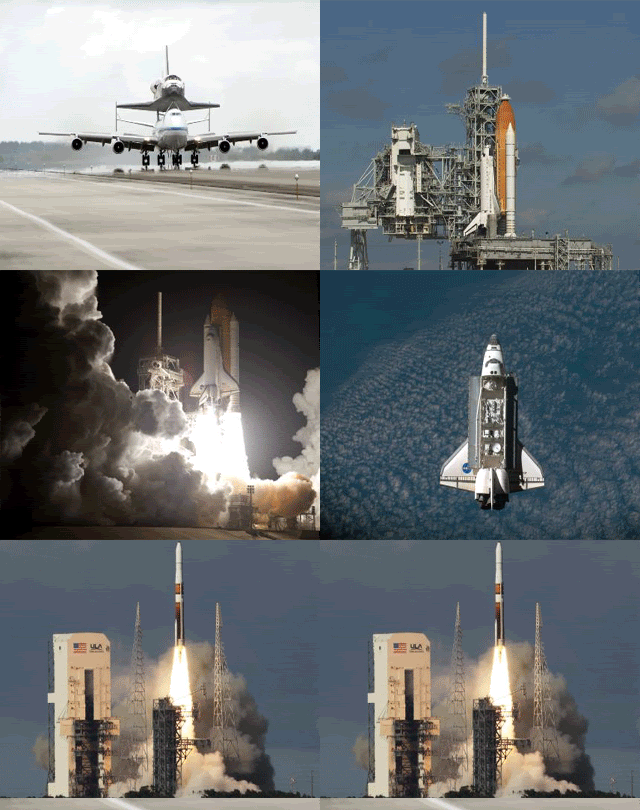
NASA has delayed the last launch of the shuttle Endeavour toward the International Space Station by at least 10 days, to April 29, in order to avoid a space traffic jam with an unmanned Russian cargo ship, also headed for the orbiting laboratory later this month. Endeavour is now targeted to blast off on its STS-134 flight on Friday, April 29 at 3:47 p.m. EDT, NASA officials said. The decision to postpone the launch removes a scheduling conflict with a Russian Progress cargo ship, which is currently scheduled to launch April 27. The robotic Progress vehicle will arrive at the station on April 29.

Discussions between NASA and its international partners have been ongoing for weeks, Beutel said, and the decision to delay Endeavour's flight was made after several other options, including moving the Progress' launch date, were deemed impractical. "Apparently there is a biological experiment onboard the Progress that has a very short shelf life onboard that spacecraft," Beutel said. "We even looked at the possibility of putting that experiment on Endeavour, but logistically that didn't work out as well." Balancing traffic at the space station and on the ground has proved challenging for the various space station partners, but is especially crucial for NASA, in order to capitalize on the unrivaled cargo-carrying capabilities of the space shuttles. The main objective of the remaining shuttle flights is to ferry supplies to the station so that the orbiting laboratory is in a good position for the years ahead, following the retirement of the agency's shuttle fleet later this year.

NASA preparing Mars rover for launch


NASA engineers are putting the finishing touches on a mega-rover to Mars before shipping it off to Florida for launch later this year. A small army of technicians dressed in protective bunny suits has been working around the clock inside a clean room at the Jet Propulsion Laboratory near Los Angeles assembling the craft, called Curiosity, and testing its science instruments. The $2.5 billion mission was supposed to launch in 2009, but problems during construction forced a two-year delay.

With launch scheduled for late November, engineers have been busy testing the spacecraft's various systems — all the while making sure that contamination from Earth doesn't accidentally hitch a ride to Mars. The nuclear-powered Curiosity — the size of a small SUV — will probe rocks and soil to determine whether the red planet ever had the right environment to support primitive life. It will carry the most high-tech instruments to the Martian surface including a laser that can zap boulders from afar. To the dismay of some space fans, Curiosity won't carry a high-resolution 3-D camera that "Avatar" director James Cameron was helping to build. NASA recently nixed it because there wasn't enough time to fully test the zoom lens before launch.

Scientists expect Curiosity to build on the discoveries of the twin rovers Spirit and Opportunity, which have uncovered geologic evidence of ancient water and the Phoenix lander, which found ice at its Martian north pole landing site. Curiosity's road to the launch pad has been bumpy. Engineers had to redesign the rover's heat shield and fix problems with the parachute. NASA also faced delivery delays from subcontractors that affected the launch timetable and raised the mission price tag.

Friday, April 01, 2011

NASA Test Stand Passes Review for Next-Generation Rocket Engine Testing


Forty-five years after its first Saturn V rocket stage test and 35 years after its first space shuttle main engine test, the A-2 Test Stand at NASA’s John C. Stennis Space Center achieved a milestone in preparation for its third major rocket engine test project. A facility readiness review in mid-March indicated all major modifications have been completed on the historic A-2 stand to begin testing the next-generation J-2X rocket engine this summer.

The new test project comes as Stennis celebrates its 50th anniversary year. On Oct. 26, 1961, NASA publicly announced plans to build the south Mississippi facility to test the massive Saturn V rocket stages for the Apollo Program. The first test of a Saturn V second stage at Stennis was performed at the A-2 stand on April 23, 1966. Stennis engineers tested 27 first and second Saturn V rocket stages for the Apollo Program, including those used to carry humans to the moon.

Thursday, March 17, 2011

Mercury Orbit Insertion


After more than a dozen laps through the inner solar system, NASA's MESSENGER spacecraft will move into orbit around Mercury on March 17, 2011. The durable spacecraft--carrying seven science instruments and fortified against the blistering environs near the sun--will be the first to orbit the innermost planet.

At 8:45 p.m. EDT, MESSENGER--having pointed its largest thruster very close to the direction of travel--will fire that thruster for nearly 14 minutes, with other thrusters firing for an additional minute, slowing the spacecraft by 862 meters per second (1,929 mph) and consuming 31 percent of the propellant that the spacecraft carried at launch. Less than 9.5 percent of the usable propellant at the start of the mission will remain after completing the orbit insertion maneuver, but the spacecraft will still have plenty of propellant for future orbit correction maneuvers.

The orbit insertion will place the spacecraft into a 12-hour orbit about Mercury with a 200 kilometer (124 mile) minimum altitude. At the time of orbit insertion, MESSENGER will be 46.14 million kilometers (28.67 million miles) from the sun and 155.06 million kilometers (96.35 million miles) from Earth.

Monday, March 07, 2011

Space shuttle Discovery during its flyaround

Space shuttle Discovery
During space shuttle Discovery's final spaceflight, the STS-133 crew members delivered important spare parts to the International Space Station along with the Express Logistics Carrier-4.

Steve Bowen replaced Tim Kopra as Mission Specialist 2 following a bicycle injury on Jan. 15 that prohibited Kopra from supporting the launch window. Bowen last flew on Atlantis in May 2010 as part of the STS-132 crew. Flying on the STS-133 mission makes Bowen the first astronaut ever to fly on consecutive missions.

Friday, February 25, 2011

Crew Checks Thermal Protection System and Spacesuits

The crew of space shuttle Discovery awoke at 6:54 a.m. EST to the song “Through Heaven's Eyes” by Brian Stokes Mitchell from the Prince of Egypt soundtrack, played for Mike Barratt at the request of his family.

Discovery will spend two days heading toward its rendezvous with the International Space Station. Today, the crew will perform the standard scan of the shuttle’s thermal protection system using the orbiter boom sensor system attached to the end of Discovery’s robotic arm. While the inspection is underway, Bowen, Drew and Stott will work on preparing the spacesuits onboard the shuttle that will be transferred to the station after docking and will be used during the mission’s two spacewalks.

Friday, January 07, 2011

NASA Research Team Reveals Moon Has Earth-Like Core

moon
Uncovering details about the lunar core is critical for developing accurate models of the moon's formation. The data sheds light on the evolution of a lunar dynamo -- a natural process by which our moon may have generated and maintained its own strong magnetic field.

The team's findings suggest the moon possesses a solid, iron-rich inner core with a radius of nearly 150 miles and a fluid, primarily liquid-iron outer core with a radius of roughly 205 miles. Where it differs from Earth is a partially molten boundary layer around the core estimated to have a radius of nearly 300 miles. The research indicates the core contains a small percentage of light elements such as sulfur, echoing new seismology research on Earth that suggests the presence of light elements -- such as sulfur and oxygen -- in a layer around our own core.

The researchers used extensive data gathered during the Apollo-era moon missions. The Apollo Passive Seismic Experiment consisted of four seismometers deployed between 1969 and 1972, which recorded continuous lunar seismic activity until late-1977.

"We applied tried and true methodologies from terrestrial seismology to this legacy data set to present the first-ever direct detection of the moon's core," said Renee Weber, lead researcher and space scientist at NASA's Marshall Space Flight Center in Huntsville, Ala.

Thursday, December 30, 2010

Cassini Celebrates 10 Years Since Jupiter Encounter

Ten years ago, on Dec. 30, 2000, NASA's Cassini spacecraft made its closest approach to Jupiter on its way to orbiting Saturn. The main purpose was to use the gravity of the largest planet in our solar system to slingshot Cassini towards Saturn, its ultimate destination. But the encounter with Jupiter, Saturn's gas-giant big brother, also gave the Cassini project a perfect lab for testing its instruments and evaluating its operations plans for its tour of the ringed planet, which began in 2004.

"The Jupiter flyby allowed the Cassini spacecraft to stretch its wings, rehearsing for its prime time show, orbiting Saturn," said Linda Spilker, Cassini project scientist based at NASA's Jet Propulsion Laboratory in Pasadena, Calif. "Ten years later, findings from the Jupiter flyby still continue to shape our understanding of similar processes in the Saturn system."

Cassini spent about six months - from October 2000 to March 2001 - exploring the Jupiter system. The closest approach brought Cassini to within about 9.7 million kilometers (6 million miles) of Jupiter's cloud tops at 2:05 a.m. Pacific Time, or 10:05 a.m. UTC, on Dec. 30, 2000.

Cassini captured some 26,000 images of Jupiter and its moons over six months of continual viewing, creating the most detailed global portrait of Jupiter yet.

Wednesday, December 29, 2010

Scans of Discovery's External Tank Progressing Well

NASATechnicians in the Vehicle Assembly Building at NASA's Kennedy Space Center in Florida are making good progress with X-ray type image scans of space shuttle Discovery's external fuel tank.

By Tuesday evening, they'll be more than half way done with the computed radiography scans of all 108 support beams, called stringers, on the outside of the external tank’s intertank section.

Engineers at various other NASA locations already are analyzing the new image scans, which began Sunday. The new data, along with previous testing and analysis, will help engineers and managers determine what caused small cracks on the tops of two stringers during Discovery’s launch countdown on Nov. 5.‬

‪‬Technicians expect to complete their scans by Thursday (Dec. 30) when Space Shuttle Program managers are set to decide whether testing and analysis indicate modifications are needed on some of the stringers.

Wednesday, December 22, 2010

Christmas at the Moon

Christmas Eve, 1968. As one of the most turbulent, tragic years in American history drew to a close, millions around the world were watching and listening as the Apollo 8 astronauts -- Frank Borman, Jim Lovell and Bill Anders -- became the first humans to orbit another world.

As their command module floated above the lunar surface, the astronauts beamed back images of the moon and Earth and took turns reading from the book of Genesis, closing with a wish for everyone "on the good Earth."

Tuesday, December 21, 2010

Total Lunar Eclipse


Early in the morning on December 21 a total lunar eclipse will be visible to sky watchers across North America (for observers in western states the eclipse actually begins late in the evening of December 20), Greenland and Iceland. Viewers in Western Europe will be able to see the beginning stages of the eclipse before moonset, and in western Asia the later stages of the eclipse will be visible after moonrise.

From beginning to end, the eclipse will last about three hours and twenty-eight minutes. For observers on the east coast of the U.S. the eclipse lasts from 1:33am EST through 5:01 a.m. EST. Viewers on the west coast will be able to tune in a bit earlier. For them the eclipse begins at 10:33 p.m. PST on December 20 and lasts until 2:01am PST on Dec. 21. Totality, the time when Earth's shadow completely covers the moon, will last a lengthy 72 minutes.

Thursday, December 16, 2010

NASA Probe Sees Solar Wind Decline


The 33-year odyssey of NASA's Voyager 1 spacecraft has reached a distant point at the edge of our solar system where there is no outward motion of solar wind.

Now hurtling toward interstellar space some 17.4 billion kilometers (10.8 billion miles) from the sun, Voyager 1 has crossed into an area where the velocity of the hot ionized gas, or plasma, emanating directly outward from the sun has slowed to zero. Scientists suspect the solar wind has been turned sideways by the pressure from the interstellar wind in the region between stars.

The event is a major milestone in Voyager 1's passage through the heliosheath, the turbulent outer shell of the sun's sphere of influence, and the spacecraft's upcoming departure from our solar system.

"The solar wind has turned the corner," said Ed Stone, Voyager project scientist based at the California Institute of Technology in Pasadena, Calif. "Voyager 1 is getting close to interstellar space."

Friday, December 10, 2010

Explosion of Infrared Light

A circular rainbow appears like a halo around an exploded star in this new view of the IC 443 nebula from NASA's Wide-field Infrared Survey Explorer, or WISE.

When massive stars die, they explode in tremendous blasts, called supernovae, which send out shock waves. The shock waves sweep up and heat surrounding gas and dust, creating supernova remnants like the one pictured here. The supernova in IC 443 happened somewhere between 5,000 and 10,000 years ago.

In this WISE image, infrared light has been color-coded to reveal what our eyes cannot see. The colors differ primarily because materials surrounding the supernova remnant vary in density. When the shock waves hit these materials, different gases were triggered to release a mix of infrared wavelengths.

Monday, December 06, 2010

the Falcon 9 Merlin 1C engines


The first SpaceX Falcon 9 demonstration launch for NASA's Commercial Orbital Transportation Services program is targeted for liftoff on Tuesday, Dec. 7. Liftoff will occur from Launch Complex 40 at Cape Canaveral Air Force Station in Florida. The launch window extends from 9:03 a.m. to 12:22 p.m. EST. If necessary, launch opportunities also are available on Dec. 8 and Dec. 9 with the same window.

Known as COTS 1, the launch is the first flight of the Dragon spacecraft and the first commercial attempt to re-enter a spacecraft from orbit. This is the first of three test launches currently planned in the Falcon 9 test flight series. It is intended as a demonstration mission to prove key capabilities such as launch, structural integrity of the Dragon spacecraft, on-orbit operation, re-entry, descent and splashdown in the Pacific Ocean.

NASA established the COTS program to procure a commercial launch service to stimulate the commercial space industry, to facilitate a private industry cargo capability to the International Space Station as soon as achievable, and to achieve cost-effective access to low Earth orbit that will attract private customers.

Friday, December 03, 2010

Shuttle Managers Continue Tank Repair Analysis


NASA space shuttle managers met today at a Program Requirements Control Board (PRCB) to review repairs and engineering evaluations associated with shuttle Discovery and cracks on two 21-foot-long, U-shaped aluminum brackets, called stringers, on the shuttle's external tank. NASA will continue to review and analyze the data before setting a launch date. NASA managers are meeting daily to assess the data and progress being made.

Technicians at Kennedy’s Launch Pad 39A will continue to collect data on the stringer repair by performing backscatter scans, which bounces radiation off space shuttle Discovery’s external fuel tank, through the weekend.

Wednesday, November 24, 2010

Inspections Complete on Repaired Tank Stringers


Teams have completed final inspections on the stringer repair work on space shuttle Discovery's external fuel tank at NASA's Kennedy Space Center in Florida. The environmental enclosure, built to support foaming operations, was removed. Flight Crew Systems middeck stow operations are under way.

The Space Shuttle Program will review the analysis and repairs that are required to safely launch shuttle Discovery on its STS-133 mission at a special Program Requirements Control Board session Wednesday. Pending a successful review of the flight rationale at that meeting, a Launch Status Briefing would be held with senior NASA management on Monday, Nov. 29 at Kennedy.

Kennedy's “Call-to-Stations” to begin the launch countdown will be no earlier than Nov. 30, supporting a first launch attempt no earlier than Dec. 3 at about 2:52 a.m. EST.

Wednesday, November 10, 2010

Space Shuttle STS-133


During space shuttle Discovery's final spaceflight, the STS-133 crew members will take important spare parts to the International Space Station along with the Express Logistics Carrier-4. Discovery has been moved to Launch Pad 39A at NASA's Kennedy Space Center in Florida.

Wednesday, October 27, 2010

Sun's Northern Hemisphere Bristling with Solar Flares

This movie show the activity on the Sun over the latest 48-hours in the 171 Angstrom emission line (showing the ~700,000K plasma) from the Atmospheric and Imaging Assembly (AIA) onboard the Solar Dynamics Observatory (SDO). With a large active region currently in the northern hemisphere of the Sun, there has been a flurry of small solar flares over the past day. This larger active region may actually be comprised of four different active regions that are very close to each other forming one large, interconnected active region with multiple magnetic poles. This magnetically complex region has lead to 12 B-class and 1 C-class solar flare over the last 24 hours.

Tuesday, October 19, 2010

Discovery Technicians Work to Resolve Small Leak

A small leak was discovered in a propellant line for space shuttle Discovery's orbital maneuvering system engines. The leak was found at a flange located at the interface where two propellant lines meet in the shuttle's aft compartment. The line carries a propellant called monomethyl hydrazine, one of two chemicals used to ignite the 6,000-pound thrust engines seen on either side of the shuttle's tail above the three main engines.

Engineers and technicians working on Discovery at Launch Pad 39A at NASA's Kennedy Space Center in Florida will tighten the six bolts around the suspect flange and re-evaluate for leaks. If that doesn't work, the propellants already inside the tanks will be pumped out and technicians will replace its primary and secondary seals.

The processing schedule could allow the two seals to be replaced without delaying Discovery's targeted launch on Nov. 1. Space Shuttle Program managers, however, are careful about making sure any potential fixes are indeed successful before pressing ahead with a countdown.

Thursday, October 07, 2010

NASA astronaut launch video


NASA astronaut Scott Kelly and Russian cosmonauts Oleg Skripochka and Alexander Kaleri launched in their Soyuz TMA-01M spacecraft from the Baikonur Cosmodrome in Kazakhstan Thursday at 7:10 p.m. EDT (Friday, Kazakhstan time) beginning a two-day journey to the International Space Station.

Less than 10 minutes after launch, their spacecraft reached orbit and its antennas and solar arrays were deployed.

The trio will dock to the Poisk module Saturday at 8:02 p.m. completing the Expedition 25 crew. Kelly, Skripochka and Kaleri will begin a five-month tour of duty aboard the orbiting laboratory.

Welcoming them aboard will be current station residents, Expedition 25 Commander Doug Wheelock and Flight Engineers Fyodor Yurchikhin and Shannon Walker. Wheelock, Yurchikhin and Walker arrived June 17 aboard their Soyuz TMA-19 spacecraft.